

Blog
How to Size a Planter to the Tree It Holds
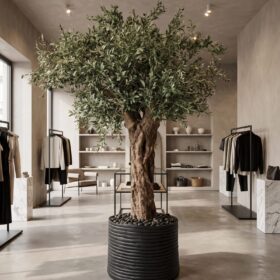
A two-and-a-half metre olive tree standing in a 40 cm planter is the most common proportion problem we are asked to correct, and the tree is almost never the thing that is wrong. The canopy is good, the trunk is good, the foliage holds up at close range. The piece still looks unsettled, because the container is too small to be read as its base. It looks like a tree in a bucket.
Sizing a planter is not a matter of taste, and it is a different question from the material it is made of. It is geometry: the tree has a footprint, a weight and a centre of gravity, and the container has to answer all three before anyone argues about colour.
Proportion is the first thing the eye reads
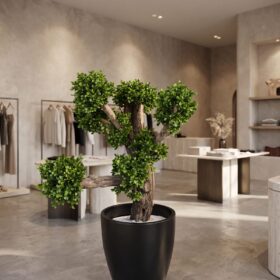
Before anyone registers bark or leaf shape, they register the relationship between the mass above and the mass below. When the planter is too shallow the tree appears to be balancing; when it is too tall and narrow the trunk looks swallowed. People sense it across a room without being able to name it.
Two relationships do most of the work:
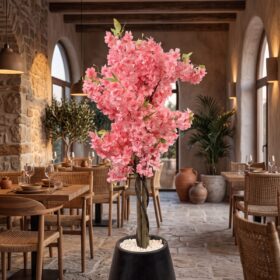
- Rim diameter against canopy spread. The planter should feel like the foot of the canopy, not a stalk under it. A wide, low-branching olive wants a broader container than a narrow, upright ficus of the same height.
- Planter height against overall height. Taller pieces need visibly more base. On a three-metre tree a knee-height planter reads as thin; on a small bonsai the same height reads as a pedestal, which may be exactly what you want.
These are judgements made in the workshop with the actual tree in front of us, which is one of the practical advantages of building both parts in the same place. The planter is not ordered from a photograph of a tree; it is cut to a tree already standing there.
Start from the trunk, not the catalogue
Because we build around preserved natural trunks, no two bases are identical. A real trunk flares. It has a root collar wider than the shaft, sometimes off-centre, sometimes with a low branch. That flare — not the diameter of the trunk at waist height — sets the minimum internal width.
So the sequence runs: trunk, then the fitting that holds it, then internal dimensions, then external ones. Reverse it and you get a container that is right in the drawing and 3 cm too narrow in the room. The fixing needs clearance too; a planter cut to the exact width of the root collar leaves nowhere for the structure that keeps the tree upright for the next decade.
Depth, weight and the tipping question
A large tree is a lever. Everything above the rim wants to rotate around the edge of the base, and the longer the lever the more mass you need low down to resist it. Depth buys that: it lets the trunk sit further down, puts ballast under the centre of gravity and shortens the effective lever arm.
Indoors, in a quiet corner, you can be moderate about this. In a corridor, a restaurant service route, a retail walkway or anywhere children pass, you cannot — the piece will be knocked, and it should shrug the knock off rather than rock. Outdoors the governing force is wind, which loads the whole canopy at once, so the planter is sized and weighted for it from the start rather than propped afterwards.
Rim height and the people around it
One dimension almost nobody specifies, and everybody notices afterwards, is how high the rim sits relative to the people near it:
- Beside seating, a rim at seated eye level puts a hard edge across a diner’s sightline. Lower it, or lift the canopy so the gap falls between heads.
- At a reception desk or host stand, a taller planter usefully screens the clutter behind the counter — a reason to go higher on purpose.
- In a shop, a wide rim at hip height collects bags, cups and hands. A narrower profile with more depth does the same structural job without becoming a shelf.
The constraints nobody measures
The last set of dimensions has nothing to do with aesthetics. A finished tree in its planter has to reach its position: through a doorway, round a stair turn, into a lift car, across a floor that may be a mezzanine or a balcony with a load limit. For a large piece we plan the route before building, and for the biggest ones the tree is assembled on site with the planter already in place.
If you are ordering a tree made to your dimensions, send the access photographs along with the room photographs. The width of a stairwell has changed more planter designs than any moodboard.
Frequently asked questions
What size planter does a 2.5 m tree need?
There is no single answer, because it depends on the trunk’s root flare, the canopy spread and where the piece will stand. We size it from the finished tree rather than from the stated height — which is why the trunk is measured before the planter is cut.
Is the height I ask for measured with or without the planter?
Always confirm this when you order. We work to overall finished height, floor to top of foliage, planter included, because that is the number your ceiling cares about. If you have a particular trunk height in mind, say so separately.
Can you fit a tree into a planter I already own?
Often, yes. Send photographs and three measurements: internal width at the narrowest point, internal depth, and rim thickness. If the planter is decorative rather than structural, the tree can be built into a fitted insert that drops inside it, leaving the original untouched.
Do outdoor planters need to be bigger?
Heavier and deeper rather than wider — the resistance to wind comes from mass and depth at the base. Outdoor pieces also use anti-UV foliage so canopy and container age at the same rate.
Bring us the room, not just the tree
The quickest way to get this right is a photograph of the position with something of known size in the frame, the ceiling height, and a note on how the piece will be carried in. We make the trees and the planters in our own workshop in Jdeideh, Metn, deliver and install nationwide, and you are welcome to stand next to finished pieces in the showroom before committing to a size.
Send your photographs and measurements on WhatsApp, or use the contact page, and we will come back with a proportion we would stand behind.