


Blog
Repairing and Refreshing an Artificial Tree Years Later
The trunk is fine. It is almost always the trunk that is fine. What has gone is the canopy — thinner than it was, a shade paler on the window side, two branches sitting at an angle nobody chose. That is the state most artificial trees reach after years in place, and the point at which owners assume the piece is finished. That assumption is wrong far more often than it is right.
An artificial tree is an assembly, not a single object, and assemblies come apart. Knowing which parts can be rebuilt, and which genuinely end a tree’s life, is the difference between replacing a piece and keeping the one you have.
What can actually be repaired
Re-leafing a tired canopy
Foliage is the part designed to be replaceable, and it is the most common job that comes back to the workshop. Leaves are attached to a branch structure, not fused to it, so an old canopy can be stripped and a new one built onto the same armature. What comes back out is the same tree — same trunk, same silhouette, same height for the same corner — in new foliage.
Partial re-leafing is often enough. A tree beside a south-facing window ages unevenly — the exposed flank loses colour while the shaded side stays close to new — and replacing one side and blending the join is far less work than a full strip.
Reshaping a canopy that has been pushed out of shape
More trees are deformed by one bad move than by a decade of standing still. A canopy squeezed through a doorway, a branch leaned on by someone cleaning behind it, a tree stored on its side — the damage is mechanical and usually reversible. Branch wire can be rebent, drooping limbs re-tensioned at the joint, crushed clusters opened out again. It is the cheapest repair there is, and the one owners least often realise exists.
Re-anchoring, re-basing and re-potting
A tree that rocks when you touch it has an anchoring problem, not an age problem: a base loosened over years, or a canopy that outgrew the weight holding it down. The fix is at the bottom — re-seating the trunk, adding ballast, or moving the piece into a planter sized to the canopy it carries. Outdoors this is not cosmetic: an under-weighted tree on a terrace is waiting for the first serious gust.
Trunk work
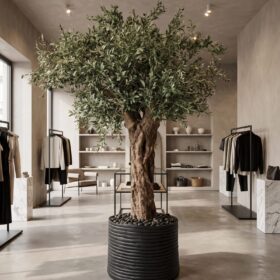
On a tree built around a preserved natural trunk, the wood is the most stable element in the whole assembly and rarely needs anything. Where it does, it is physical: a branch broken off in transport, a split that has opened at a join, a tree that needs to lose height for a lower ceiling in a new flat. Real wood can be cut, rejoined and re-finished. A moulded plastic trunk, by contrast, is one piece — when it cracks, there is not much to work with.
What is not worth repairing
Three honest exceptions. An internal armature that has corroded — usually a tree left outdoors for years without outdoor-grade construction — cannot be made sound by working on the outside. Brittle foliage, where leaves snap rather than bend between your fingers, cannot be revived, only replaced. And a tree built badly to begin with, trunk never properly seated and branches on wire too thin for their length, will present the same fault after every fix.
Even then the trunk may be worth keeping. Good wood can carry a new frame and a new canopy — a rebuild rather than a repair, but one that starts from something.
Assessing your own tree in five minutes
- Push the trunk gently at chest height. Movement at the base means anchoring, not age.
- Bend one leaf in half. If it springs back, the foliage has life left. If it cracks, that canopy is done.
- Wipe one leaf with a damp cloth and step back. If that leaf is now visibly greener than its neighbours, you have dust, not fading, and the tree needs cleaning rather than work.
- Look at where branches meet the trunk. Sagging at the joints is a tensioning job; a clean joint with a tired tip is a foliage job.
Why where a tree was made decides whether it can be fixed
A tree that arrived in a container from a catalogue has no workshop behind it. Nobody local knows how its canopy was attached or how its base was weighted, so even a straightforward re-leaf becomes guesswork.
Because we build everything at our workshop in Jdeideh, a piece we made can come back to the bench it was built on. It is also why we will look at trees we did not build — we can usually tell from a photograph whether one is worth the effort, and we would rather say no than take on a piece that will fail again.
Prices and sizes for stock pieces are listed with our artificial plants and trees, all available to see in the Jdeideh showroom.
Frequently asked questions
Is refreshing a tree cheaper than buying a new one?
Usually, because the costly, characterful part — the trunk — is what you keep. How much cheaper depends on the size of the tree and how much canopy is being replaced, so it is a conversation with a photograph rather than a fixed figure.
Can you match foliage on a tree you did not make?
Sometimes exactly, often closely. Where an exact match is not possible, re-leafing the whole canopy in one consistent foliage looks better than a patch that almost matches.
Do I have to bring the tree to you?
For small pieces that is easiest. For large installations we work from photographs first, and since we deliver and install nationwide, collection and return can be arranged.
How long does a refresh take?
Less than a new build, which runs roughly 20–25 working days for a custom tree. A reshape or a re-base is quick; a full re-leaf on a large canopy is the longer end.
Send us a photograph of it
If you have a tree that has stopped looking its best, two or three photographs are usually enough for us to tell you which of the jobs above it needs — or that it only needs a dusting. Message us on WhatsApp or through the contact page.
And if you are still choosing, it is worth asking before you buy: can this piece be serviced in six years? Our custom artificial trees are made to any size in our own workshop, which is the whole reason they can be. Finished pieces are standing in the Jdeideh showroom, facing St John Greek Orthodox church, and we are rated 5.0 on Google.









Pingback: How Long Does an Artificial Tree Last? Indoors, Outdoors and in the Sun - Neon Jungle Studios
Pingback: How to Clean a Dusty Artificial Tree: Tools, Steps and What to Avoid - Neon Jungle Studios
Pingback: How to Clean a Dusty Artificial Tree | Step-by-Step Guide
Pingback: How Long Does an Artificial Tree Last? Indoors vs Outdoors