

Blog
Villa Entrances and Driveways: Outdoor Artificial Trees That Hold Up
A villa is read twice before anyone reaches the door. Once from the road, at driving speed, where only mass and silhouette register — and once on foot between the gate and the entrance, where everything is close enough to touch. Greenery has to survive both viewings, and it is usually the second one that catches people out: a tree that looked right in a photograph of the elevation turns out to be standing in a planter a child could tip, with foliage gone pale on the side that faces the afternoon.
The approach is a sequence, not a single spot
There are three positions that decide whether an entrance works, and they are not equally served by one tree beside the door.
The first is the gate or the road. At that distance nobody sees leaves — they see outline and height against the building. The second is halfway along the drive, where grouping and rhythm start to matter: whether the planting repeats, steps up, or sits in one lump. The third is standing at the door waiting for it to open, where a visitor has nothing to do but look at bark, leaf edges and the rim of a planter from half a metre away.
Most villa entrances read better with one large piece carrying the silhouette and two or three smaller ones establishing a rhythm along the approach, than with a single tall tree doing all the work alone. The repetition is what makes an arrival feel designed rather than decorated.
Where outdoor pieces actually fail
Sun
A west-facing drive in Lebanon takes the hardest light of the day, every day, for months. Anti-UV foliage matters here because the stabilisation is in the polymer of the leaf itself, not sprayed on afterwards as a coating that weathers off. Indoor foliage moved outdoors will hold its colour for a season and then go chalky, usually unevenly — pale on the sun side, still green on the other, which is the most obvious way for a piece to announce itself as artificial. If an entrance is exposed, the foliage specification is not a detail to leave to chance.
Wind
Gates and the gaps between a house and its boundary wall channel wind in ways an open garden does not. A heavy planter and an anchored piece are not the same thing: weight resists sliding, but what topples a tall tree is leverage at the top of the canopy. Outdoor pieces for exposed positions want a low centre of mass, ballast placed properly inside the planter rather than loose soil on top, and in the worst positions a fixing down into the paving.
Water
Driveways are built to shed water somewhere, and a planter standing at the place where it collects will sit in a puddle after every storm. That is how steel planters start bleeding rust marks onto pale stone. Drainage holes, feet or a plinth that lifts the base clear of the surface, and a few minutes spent watching where water actually runs during rain will save a finish that is otherwise expensive to put right.
Sizing against a façade, not a room
Indoors you size a tree to a ceiling. Outdoors there is no ceiling, so the reference becomes the building: the head height of the door, the line of a first-floor balcony, the top of a boundary wall. A tree that feels generous in a living room can read as a shrub against three storeys of stone. Canopy width matters more outdoors too, because nothing contains it — a two-metre spread that fits a corner indoors will overhang a metre of a two-metre-wide path and get brushed by every person and car that passes.
The useful exercise is to stand where visitors stand, photograph the façade, and mark where the top of the foliage should land. We quote custom artificial trees from exactly that kind of photograph.
The driveway constraints nobody mentions
Car doors open. Vehicles reverse, and reversing drivers look at the mirror, not the planter. Gates swing or slide through an arc that has to stay clear. Service access has to reach the bins, the generator and the water tank. Every one of those is a reason a planter gets knocked, and it is worth deciding placement with the car in mind rather than the photograph — set back from turning points, out of the swing of the gate, and ideally against something solid rather than standing alone in the middle of a manoeuvring area.
Material choice follows from the same logic. Fiberglass takes a knock without denting and stays lighter; steel and aluminium survive contact better but need their finish specified for an outdoor life. We build custom planters in all three, sized to the piece they hold rather than to a standard range.
What we build for outdoor entrances
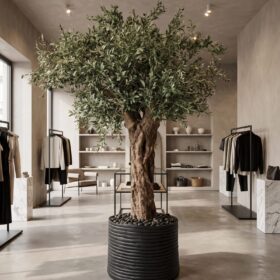
Everything is fabricated in our own workshop in Jdeideh, Metn — not imported and resold — which is why an outdoor specification can be decided piece by piece rather than chosen from whatever arrived in a container. Olives built around preserved natural trunks handle an entrance better than most alternatives, because real bark at close range is what settles the question for a visitor standing at the door; you can see how that works on our artificial olive trees. Palms, ficus, bougainvillea and mixed artificial landscaping for driveways and garden edges are built the same way, to any size, with delivery and installation anywhere in Lebanon.
Common questions
Can an artificial tree really stay outdoors all year in Lebanon?
Yes, if it was built for it. That means anti-UV foliage, an outdoor-rated planter with drainage, and ballast suited to how exposed the position is. A piece built for an interior will not last outdoors, which is the source of most disappointment.
How long does a custom piece take?
Around 20 to 25 working days for a custom tree, since the trunk, frame, foliage and planter are all built for the specific position.
Do outdoor pieces need any maintenance?
Less than planting, but not nothing. Rain does most of the cleaning; what helps is rinsing dust off before it bakes on in summer, and checking after a storm that nothing has shifted.
Planning an entrance?
Send a photograph of the approach — from the gate and from the door — and we will tell you what size and specification the position actually needs. Message us on WhatsApp or through the contact page, or visit the showroom in Jdeideh, facing St. John Greek Orthodox church, to see outdoor foliage and planter finishes in person before you decide.