

Uncategorized
Inside the Jdeideh Workshop: The Materials and Tools Behind a Custom Tree
There is no single machine that makes an artificial olive tree. People sometimes imagine one — something you feed a trunk into at one end and collect a finished piece from at the other. What our workshop in Jdeideh actually holds is a set of benches, each with its own pile of raw material, and a tree is what happens when a person moves between them for a few weeks.
That matters to a buyer more than it sounds. Because every piece we sell is made in our own workshop rather than ordered finished from a catalogue, the materials on those benches are the materials in your tree. Here is what they are, and what each one decides about the piece you end up living with.
Bench one: the trunk
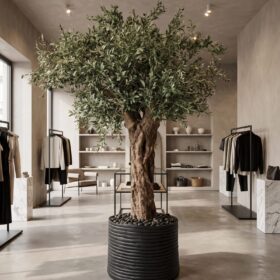
The heaviest thing in the room is usually a stack of preserved natural trunks — real olive wood, treated so it stays stable indoors and outdoors instead of drying, splitting further or shedding. They arrive as found objects, not as stock. One leans hard to the left. One has a hollow you can put a hand into. One branches low, which rules it out for a tree that has to stand beside a door.
Preparing a trunk is mostly subtractive work: cleaning it back, removing anything loose or soft, opening the points where branches will be fixed, and sealing it. The tools are the ones any joinery bench has — brushes, chisels, drills, sanding blocks. Nothing exotic. The skill is in knowing when to stop, because every pass you make takes away some of the irregularity that was the reason to use real wood at all.
Bench two: steel
The canopy of a large tree is carried on a metal structure fixed into the trunk, so the welding and cutting bench sits close to the wood. Branch armatures are cut, shaped, and welded or mechanically fixed, then dressed so nothing sharp or shiny stays exposed where a hand might land.
Steel is also what makes a tall tree safe. A two-and-a-half metre canopy puts real leverage on whatever holds it, and the connection between trunk and branch is the joint that gets tested every time the piece is moved, cleaned or knocked. Building it in metal rather than glue is the difference between a tree that survives a house move and one that arrives at the new address with two branches in a bag.
Bench three: foliage
Foliage comes in crates of stems rather than finished canopies, which is why density is a decision here and not a specification somewhere else. Stems are sorted by leaf size and shade before anything goes on, because a convincing olive canopy is not one green — it runs from grey-silver on the outside to a darker tone underneath, and mixing those is what stops a tree reading as a manufactured surface.
Two grades sit on that bench. Indoor foliage, which is softer and often finer in the leaf, and anti-UV foliage, which carries ultraviolet stabilisers through the material so it holds colour under direct sun. The second is what goes on anything destined for a terrace, a pool deck or a villa entrance. It is specified at the start of a custom tree project, not added later, because you cannot retro-fit UV resistance into leaves that were never made with it.
Bench four: planters and ballast
The planter bench is the one that surprises visitors, because it looks like metalwork rather than décor. Fiberglass is laid up in moulds and finished; steel and aluminium planters are cut, folded, welded and coated. Either way the inside matters as much as the outside: a planter that holds a tall tree needs the trunk anchored and the weight sitting low, so ballast is built in rather than poured in on delivery day.
This is the quiet reason to have the tree and its container made in the same place. When the two are made separately, the planter is sized from a photograph and the weighting is a guess. When they are made on adjacent benches, the base is engineered for the actual tree standing in it.
The other half of the room
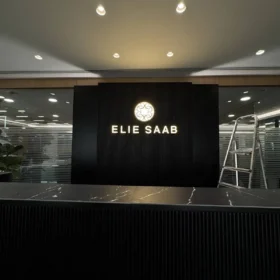
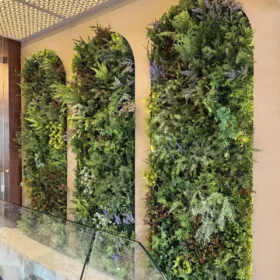
The same workshop makes neon signs, 3D letters and sculptural pieces, which is why you will find glass tube and bending flames at one end and acrylic sheet, LED neon flex and aluminium channel at the other. It sounds like an unrelated business. In practice the two feed each other — the metalwork skills that build a branch armature are the ones that build a sign tray, and a green wall with lettering across it is a single job rather than two suppliers and a coordination problem.
What a buyer can read from a materials list
If you are comparing greenery, ask what it is made of before you ask what it costs. A real preserved trunk, a metal branch structure, foliage specified for where the piece will live, and a planter weighted for the tree it holds — those four answers tell you most of what you need to know. A seller who can give them is describing something they made. A seller who cannot is describing a box that arrived.
Everything above is on view in the showroom in Jdeideh, facing St. John Greek Orthodox church, and the workshop is behind it. Touching a trunk and a foliage stem takes about a minute and settles questions that photographs never will.
Frequently asked questions
Can I see the materials before I commit to a custom piece?
Yes. Trunks, foliage grades and planter finishes are all in the showroom, and for a custom tree we would rather you chose the trunk yourself than approved it from a photograph.
Is anti-UV foliage worth it for an indoor tree?
Usually not for a shaded interior. It becomes worth it for anything standing in a bright window, a glazed atrium or a stairwell with direct afternoon sun, where ordinary indoor foliage will pale on the lit side.
How long does a custom tree take to build?
Around 20 to 25 working days for a custom tree, depending on size and the trunk selected. Ready-made pieces in the showroom go out far faster.
Do you deliver and install outside Beirut?
Yes — we deliver and install nationwide, and large pieces are installed by our own team rather than handed over at the door.
Talk to the people who build it
If you have a corner, a wall or a sign in mind, send us a photograph and the ceiling height and we will tell you what it needs. Message us on WhatsApp or use the contact page — and if you are near Jdeideh, come and put your hand on a trunk first.