

Blog
Artificial or Preserved Plants: What the Difference Actually Means for a Buyer
Preserved, stabilised, natural-touch, real-touch, artificial — five words that can sit on five labels in the same shop while describing three genuinely different products. Two of the three are real plants. One is not. The distinction decides where a piece can live, how you are allowed to clean it, and whether it is still worth looking at after a Lebanese summer.
What a preserved plant really is
A preserved plant — also sold as a stabilised plant — began as a living one. While it is still full of sap, it goes through a process that replaces that sap with a glycerin-based solution. The plant stops growing but keeps its cell structure, its flexibility and, with added pigment, its colour. Nothing is moulded or printed. Every leaf is a real leaf.
That is also where the limits come from. A preserved leaf is still organic material and behaves like it. It has no defence against ultraviolet light, so direct sun bleaches it. It is hygroscopic, meaning it draws moisture back out of damp air — which is why preserved moss can go limp, darken or spot in a humid stairwell, a bathroom or a ground-floor space that never quite dries out. You cannot rinse it, you cannot wipe it with a wet cloth, and you cannot put it outdoors at all.
Preserved pieces belong indoors, out of direct sun, in rooms that stay reasonably dry. Even there the material is quietly ageing, so its useful life is measured in years rather than decades. Where it earns its place is close-range work: moss panels behind a reception desk, a boutique wall people stand an arm’s length from.
What an artificial plant really is
An artificial plant is manufactured — most often polyethylene leaves moulded from real foliage, assembled onto a wire or steel frame. Quality varies enormously, and that variation is the honest reason artificial greenery carries a mixed reputation. A thin leaf with one flat colour and a visible moulding seam reads as fake from three metres away. A multi-tone leaf with real veining, a matte surface and some variation in size and angle does not.
What the material buys you is indifference to its surroundings. Foliage made with anti-UV additives holds its colour on a terrace through August. Dust is handled with a soft brush and a damp cloth rather than a specialist. Humidity is simply not a factor. There is no slow organic decline happening underneath the colour.
The hybrid most large trees actually are
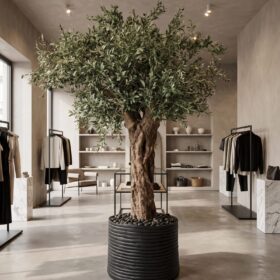
The third category is the one that confuses people most, and it is what nearly every convincing large tree in Lebanon actually is: a preserved natural trunk carrying artificial foliage.
The reason is simple once you have touched both. Bark cannot be faked well — it is a record of decades of growth, and a moulded trunk gives that away at the first glance, especially on a thick olive. Foliage is the opposite case: a real preserved canopy on a two-and-a-half metre tree would need shade, dry air and careful handling forever, while anti-UV artificial foliage needs none of that and can be built to whatever density the room calls for.
So the convention in a serious workshop is to put the real material where realism is decided and the durable material where durability is decided. That is how we build custom artificial trees in our own workshop in Jdeideh, and it is why a well-made artificial olive tree survives a question that a fully synthetic one does not: someone running a hand along the trunk.
Choosing between them
Three questions settle it in most cases.
Is the piece going outdoors, or near a window that gets direct sun?
Then it is artificial, with anti-UV foliage. Preserved material is not a candidate — this is not a preference, it is what the material can and cannot do.
Is the space humid, or does it swing between damp and dry?
Artificial again. Coastal ground floors, pool areas and spa rooms are hard on preserved foliage and completely uneventful for artificial.
Will people stand within arm’s reach of it, in a controlled interior?
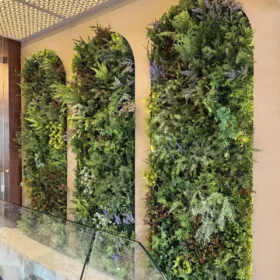
Preserved becomes genuinely attractive here, particularly for moss. But compare it against a good artificial panel first: the gap at that distance is smaller than people expect, and the maintenance rules are far less demanding. Most of the green walls we install are artificial for exactly that reason.
How to tell what you are being shown
Four checks, none requiring any knowledge of greenery:
- Bend a leaf back on itself. Artificial polyethylene springs back. Preserved material is softer, slightly suede-like, and does not have that snap.
- Look at the seam. A moulded leaf has an edge line where the mould closed. A real leaf does not.
- Ask whether it can be washed. If the answer is no, the material is organic — preserved, not artificial — whatever the label says.
- Ask whether it can go outdoors. A confident yes should be followed by your question about which component is UV-treated. On a tree, that separates people who made it from people who unpacked it.
Frequently asked questions
Is a preserved plant the same as a dried plant?
No. A dried plant has had its moisture removed and is brittle and fragile. A preserved plant had its sap replaced, so it stays flexible and keeps its colour.
Can preserved moss be used in a bathroom or a spa?
It is a poor choice. Preserved moss reabsorbs moisture from humid air and can go limp or develop spotting. For wet or humid rooms, an artificial panel is the sensible choice.
Do you make preserved plants?
We fabricate artificial greenery — trees, green walls, planters and landscaping — in our own workshop, and we use preserved natural trunks as the structural heart of our custom trees. Tell us the room and we will tell you plainly which construction suits it.
Which lasts longer?
Artificial, in almost any real-world Lebanese setting, and by a wide margin outdoors or in humidity. Preserved material is a finish for protected interiors, not a long-term structural choice.
Not sure which you need?
Send us a photo of the space, tell us whether it is indoors or out and how close people will stand to it, and we will tell you which construction actually fits. Everything we make is built in our own workshop in Jdeideh, Metn, to any size, with nationwide delivery and installation — and the showroom facing St. John Greek Orthodox church is open if you would rather touch the materials first.
Message us on WhatsApp or use the contact page.