

Uncategorized
Seasonal Refreshes: Changing the Look Without Changing the Tree
Nobody gets tired of a good olive tree. What people get tired of is the half-metre of floor around it, the planter they chose in a hurry, and the fact that the corner has looked identical since the day it was installed. The tree is almost never the problem — and replacing it is almost never the answer.
A well-built piece is a permanent fixture, closer to a stone countertop than to a sofa. The things around it are cheap, quick and reversible, and changing two or three of them will change how the whole corner reads.
Start with the planter, not the tree
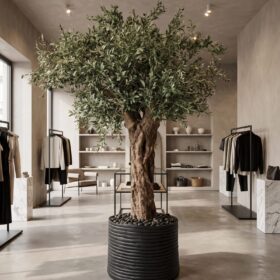
The container is the single biggest visual change available to you, and the one people least expect. Swap a matt black fibreglass cylinder for a ribbed terracotta-toned one and the same olive tree stops reading as hotel-lobby and starts reading as Mediterranean house. Go the other way — brushed aluminium, a square profile, a plinth base — and it reads contemporary and commercial.
Because the tree sits in its own internal base, the outer planter is effectively a sleeve. That means a refresh is a genuine option rather than a rebuild: the piece is lifted, the new container set in place, the weighting checked, and the tree reseated. If you are considering this, measure the rim diameter and the internal depth of what you have now before you look at anything new, and read our note on custom planters — matching the proportion matters more than matching the colour.
Re-dress the base
The surface at the foot of the trunk is a few centimetres of material that most people never revisit. It is also what the eye lands on when someone is standing right beside the piece.
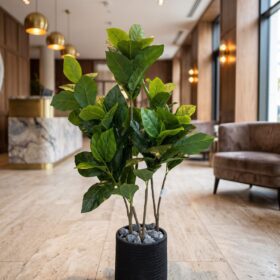
- River stone or pebble reads clean and architectural, and suits lobbies, clinics and offices.
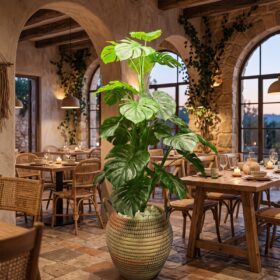
- Bark and dried moss reads natural and warm, and is the usual choice for homes and restaurants.
- Preserved moss in a flat, even layer reads modern and deliberate, especially under a single-trunk tree.
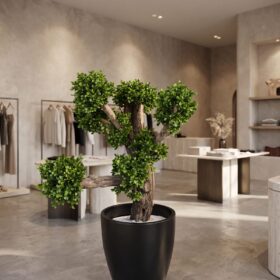
- Low understory foliage — a few short ferns or grasses tucked at the rim — softens the hard line where planter meets trunk and makes the whole piece look more established.
This is a twenty-minute job and the cheapest change on the list. It is also the one that most often fixes the complaint “it looks a bit fake up close”, because a bare base is one of the strongest giveaways there is.
Change the light before you change anything else
Greenery absorbs light, so greenery that is lit flat from a ceiling panel goes dull and shapeless. A single narrow-beam spot aimed down through the canopy puts the leaves in relief and throws a shadow pattern onto the floor and wall, which is most of what makes a tree feel like it belongs in the room.
Moving an existing fitting, or adding one uplighter at the base angled up the trunk, costs very little and transforms a piece you already own. In a commercial space a line of warm script above a planted corner does the same job twice over — our note on custom neon signs covers how the two materials work together.
Seasonal accents that come out again
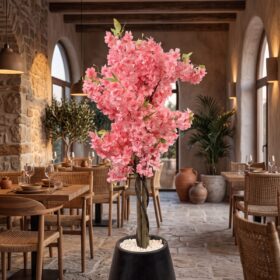
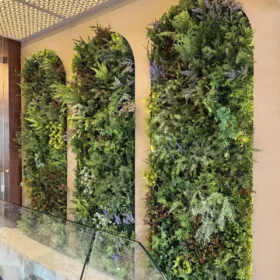
The genuinely seasonal layer should be the layer you can remove. Blossom stems wired into an olive canopy for spring, bougainvillea threaded along a green wall edge for summer, dried wheat and seed-head tones in autumn, and something simple and warm in December — all of it attaches and detaches without touching the structure of the piece.
Two practical rules. Keep accents at or above eye level where they are seen but not handled, and keep a labelled box for each set so what goes up in spring is still usable the following spring. Loose stems crushed under something heavy for eleven months come out looking tired, and then get thrown away and bought again, which defeats the point.
A rhythm that works in Lebanon
Most spaces here need two real changes a year. One in late spring, when the light gets harsh and terraces come back into use — the moment to move pieces, refresh the base dressing and add flowering accents. One in late autumn, when the indoor season starts and lighting matters again. A third, lighter pass in December if the space is public-facing. That cadence also gives you a natural point to dust the foliage and check the anchoring on anything outdoors.
When a refresh is not the right answer
If the foliage has gone pale on one side, or branches have been bent out of position and no longer spring back, you are past the point where accessories help. That is a workshop job — refoliating, rebalancing the canopy, sometimes rebuilding a branch — and it is worth doing on a piece with a good preserved trunk, because the trunk is the expensive part and the part that does not age badly. For a tree that was built around the wrong proportions for the room in the first place, the honest answer is a new canopy or a new piece; our page on custom artificial trees explains how we work to a specific height and width.
Frequently asked questions
Can you change the planter on a tree I bought elsewhere?
Usually, yes. We need the rim diameter, the internal depth and an idea of the weight, and we will want to see the base of the tree before committing — some are fixed into their container in a way that makes a straight swap impractical.
Will adding blossom stems damage the foliage?
Not if they are wired on rather than pushed into the canopy at random. Wiring distributes the load along a branch; forcing stems between leaves is what breaks them.
How often should the base dressing be replaced?
Bark and moss are worth refreshing every couple of years indoors, sooner on a terrace where wind lifts the lighter material. Stone lasts indefinitely and only needs rinsing.
Thinking about a refresh?
Send us a photograph of the corner as it stands now and we will tell you honestly whether it needs a new planter, a better base, a light in the right place, or nothing at all. Message us on WhatsApp or through the contact page, or come and see the pieces in person at the showroom in Jdeideh, facing St. John Greek Orthodox church — everything we sell is made in our own workshop a few steps away.