

Blog
What to Check on Delivery and Installation Day
Delivery day is the last moment when a problem is cheap to fix. Once the van has gone, a planter standing proud of the wall or a canopy facing the wrong way becomes something you live with — or something you arrange a second visit for. While the piece is still in people’s hands, all of it is a two-minute adjustment.
The day before: clear the route, not just the spot
Most delivery problems in Lebanon are access problems, and almost all of them are known in advance. A two-metre tree in a planter cannot be tipped on its side without pressure going through the branches, and it will not fold.
Walk the route the piece has to travel, not just the room it is going into: the lift’s internal height and the diagonal of its door, the tightest turn on the stairs, the swing of the entrance door, and whether anything is parked where a van needs to stop. If the lift is out, say so before the day — a stairwell carry is a different job, better planned than discovered.
In the room, clear more floor than the planter’s footprint: the piece needs somewhere to be set down and assessed before it goes to its final position.
The five-minute check on the piece itself
1. The trunk in the planter
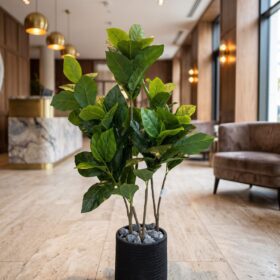
Put a hand on the trunk at chest height and push gently. A well-built piece moves as one object — the planter wants to shift before the trunk does anything independently. If the trunk rocks inside a planter that stays still, that is a workshop matter, not something to solve with a wedge.
2. The canopy’s best face
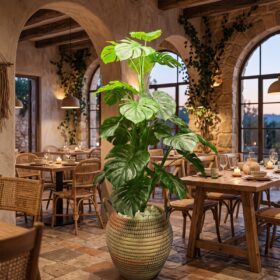
Every tree built around a preserved natural trunk has a better side, because real bark is not symmetrical. Step back three or four metres and decide which face points at the room’s main sightline — the door, the seating, the angle you already know people photograph. Rotate it then, with help in the room, rather than dragging a loaded planter across tiles later.
3. Foliage distribution
Look up through the canopy from underneath, then from across the room. Branches travel bundled and arrive compressed; spreading them by hand is part of the install, not a fault. What you are checking for is gaps that persist after they have been opened out.
4. The planter and the base
Check the visible face of the planter for transit marks — scuffs from a stairwell are worth raising while the piece is still accessible. Then look at where it meets the floor: it should sit flat, with no rock when pushed at the rim. On an uneven tiled terrace, levelling is done at install, not noticed a week later.
Green walls: the edges tell you everything
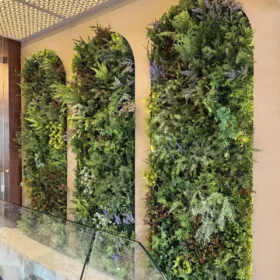
A green wall is a grid of panels, and a convincing one hides that fact. Stand close and follow every seam with your eyes, then step back and do it again. The joins should disappear into foliage rather than read as straight lines, and the foliage should turn the corner at the wall’s outer edge rather than stopping flat where the panel ends.
Check the perimeter against whatever the wall meets — skirting, a ceiling line, a counter, a door frame. Trimming and infill at those boundaries is the fiddly part of a green wall, and worth having done properly while someone is on a ladder in front of it. Then press a palm flat against the middle of a panel: it should feel fixed, not springy.
Outdoor pieces: anchoring happens now or never
For anything going on a terrace, a roof, a driveway or a seafront deck, anchoring and weighting are part of the installation. The first real wind of the season is not the moment to start thinking about it.
Ask how the piece is secured and against what: weight in the planter, a fixing to the floor, or placement against a solid element. If a position looks exposed, moving it a metre while four hands are available costs nothing.
Placement: decide while help is still in the room
The most useful thing you can do on install day is resist the urge to be finished. Have the piece set down roughly where you planned it, then go and stand in the doorway, sit in the chair people actually sit in, and walk past it the way staff will.
Trees almost always want to be slightly further from the wall than instinct suggests — a gap behind the canopy is what reads as a tree standing in a room rather than a decoration pressed against plaster. In a commercial space, check sightlines too: nothing decorative should sit between an arriving guest and the thing they are looking for.
What to raise now, and what can wait
Raise on the day anything structural — a trunk that moves independently of its planter, a panel that is not solidly fixed — plus anything affecting position, visible damage, and outdoor anchoring.
What can wait is the canopy settling in. Foliage relaxes over the first days after a piece is opened out, and a branch you were unsure about on the first evening often sits correctly by the weekend.
Frequently asked questions
Do I need to be there for the installation?
Someone who can make decisions about position should be. The carrying and fixing is our work, but placement, orientation and sightlines are judgement calls about your room — far easier to get right with you standing in it than over a phone call afterwards.
What if something is damaged in transit?
Point it out while the piece is still in front of you and photograph it if you can. We build everything in our own workshop in Jdeideh, so putting right a scuffed planter or a branch bent in a stairwell is an internal job rather than a conversation with a supplier abroad.
Can a piece be moved to another spot later?
Yes, though large pieces are heavier and more awkward than they look, and the canopy is what suffers from improvised handling. If a move is likely, mention it at the start — it can change how the base and planter are built.
Before you order
Everything we deliver is made in our own workshop in Jdeideh, Metn, and installed by us anywhere in Lebanon — so the people setting a piece down in your room are the people who built it. You can also see finished work in the Jdeideh showroom first.
To talk through a piece, access, or an installation date, message us on WhatsApp or use the contact page.