

Uncategorized
The Showroom in Jdeideh: What You Can See Before You Order
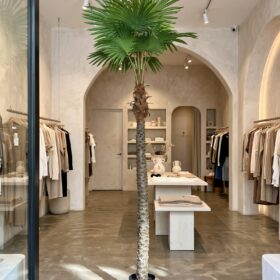
Walk in through the door facing St. John Greek Orthodox church, and the useful part of the visit begins once you stop looking at the room and start touching things. A showroom full of greenery photographs well, which is exactly the problem — photographs are the one thing you already had before you came. What a visit gives you is everything a camera cannot carry: weight, surface, the sound a branch makes when you move it, and the point at which a piece stops convincing you.
Our showroom sits in Jdeideh, Metn, in front of the workshop where the pieces are made. That arrangement is the reason a visit is worth the drive, and it shapes what you should do once you are inside.
Why a photograph cannot settle the question
Every artificial tree looks good in a photograph. Lighting is controlled, the angle is chosen, and the lens flattens the two things that actually decide realism: depth of canopy and texture of bark. A tree with thin foliage looks full head-on and hollow from the side. A moulded trunk looks acceptable at two metres and plastic at arm’s length. Neither failure survives a photograph, and neither survives standing next to the piece.
So the visit is not about choosing a species or a colour. You can do that online. It is about calibrating your eye — learning what a good one feels like, so that every piece you see afterwards, here or anywhere, is measured against something real.
What to touch, in order
The trunk
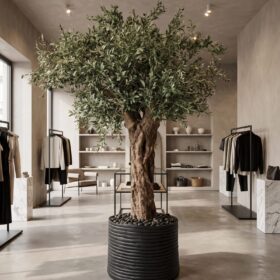
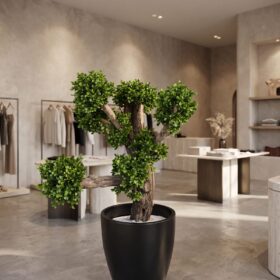
Start with your hand, not your eyes. We build around preserved natural trunks, so bark under your palm should read as a record of growth: splits that opened over years, hollows where a branch was lost, grain that changes direction because the tree did. Run your hand down a moulded trunk afterwards and the difference is immediate — repetition, a seam, the same temperature everywhere. You only need to do this once to never need telling again. Our artificial olive trees are the easiest place to feel it, because olive bark is the most characterful surface we work with.
The foliage
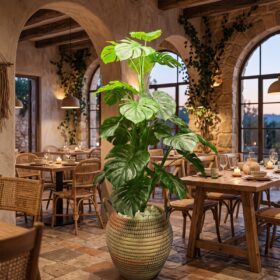
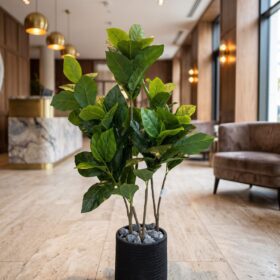
Pick up a single leaf and look at the back of it. Veining on both faces, variation in tone from one leaf to the next, a stem that bends rather than snaps — those are the signs of foliage made to be looked at closely. Then step back and look at the canopy from the side. Can you see daylight through the middle? Does the density continue inward, or is it a shell of leaves on an empty frame? Ask which foliage is anti-UV rated and which is not; it matters enormously if the piece is going outdoors, and not at all if it is going into a stairwell.
The planter and the base
Push the top of a tall tree gently with one finger. A well-weighted piece resists and returns; a badly based one tells you by rocking. Then look at the planter it is standing in — the rim thickness, the finish, whether the proportion to the canopy feels right or slightly mean. Planters are the part of an order people decide fastest and regret longest, and the showroom is where you can compare a custom planter against a stock one with your own eye rather than from a swatch.
The part most showrooms cannot show you
Behind the display space is the workshop. That means a visit can include things a retail floor has no answer for: a trunk waiting to be built onto, foliage in progress on a frame, a planter being finished. If you want to understand what you are buying, standing in front of a half-built tree does more in five minutes than any brochure — and it is the reason the factory and showroom occupy the same address rather than two different ones.
It also changes the conversation. When the people discussing your project are the people who will build it, a question like “can the canopy lean left to clear a beam?” gets answered on the spot instead of being referred to a supplier abroad.
What to bring with you
Three things make a visit far more productive:
- A photograph of the actual space, taken from the doorway, with something of known size in frame — a chair, a door. Badly taken is fine; we are looking at proportion, not composition.
- Two measurements: ceiling height, and the width available for the canopy. Those two numbers decide more about the final piece than the species does.
- A note of your light: direct sun through glass, shaded interior, or fully outdoors. This determines which foliage is appropriate before anything else is discussed.
If the piece needs to be built to a size that does not exist on the floor, that conversation starts here too — a custom artificial tree is made to the room, and the lead time for one is roughly twenty to twenty-five working days.
Questions worth asking out loud
Ask where the piece is made. Ask whether the trunk is natural or moulded. Ask whether the foliage is rated for outdoor sun. Ask what happens in three years if the canopy thins on the window side. Good answers are specific and come quickly; vague ones are their own information.
FAQ
Do I need an appointment to visit?
You are welcome to walk in during opening hours. If your project is a custom piece, or you want to discuss drawings, message us on WhatsApp first so the right person is there when you arrive.
Can I buy something on the day?
Yes — pieces on the floor can be bought and taken or delivered. Anything built to a specific size is made to order in the workshop behind the showroom.
Can you come to my space instead?
For larger installations we do site visits anywhere in Lebanon, and we deliver and install nationwide. For a single tree, a photograph and two measurements are usually enough to work from.
Is everything in the showroom made by you?
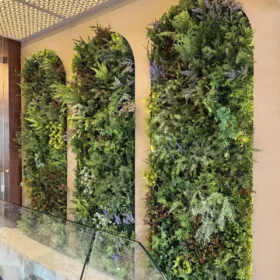
The trees, green walls, planters, signs and sculptures we fabricate are made in our own workshop in Jdeideh, Metn.
Come and see it
The showroom is in Jdeideh, Metn, facing St. John Greek Orthodox church. Message us on WhatsApp with a photo of your space before you come and we will have something relevant on the floor to show you, or use the contact page if you would rather write. Bring the measurements — the rest is easier in person.