

Blog
Staircases and Double-Height Spaces: How to Fill Vertical Volume
Measure a double-height living room and you find a second room nobody uses. Six metres of ceiling above a sofa, four or five metres of blank plaster beside a staircase — volume that was expensive to build, appears in every photograph of the space, and holds nothing. Stairwells and double-height voids are the most common unfinished surfaces we are asked about, and they stay unfinished because the usual solutions are the wrong size for them.
Why ordinary greenery disappears in a tall space
A two-metre tree is a substantial object under a 2.8 m ceiling. Put the same tree at the foot of a six-metre void and it reads as a potted plant, not as part of the space. The eye in a tall room does not stop at head height; it travels up, finds nothing, and registers the upper volume as empty. Adding more small pieces at floor level does not fix that, because the problem is not quantity — it is that nothing occupies the part of the room people are looking at.
Stairwells add a second difficulty: they are read while you move. A piece beside a staircase is seen from the bottom step looking up, from mid-flight at arm’s length, and from the upper landing looking down. Those are three different viewing distances, and a piece that only works from one of them looks wrong from the other two.
Three ways to fill the volume
One tall tree, sized to the void
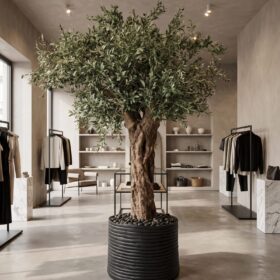
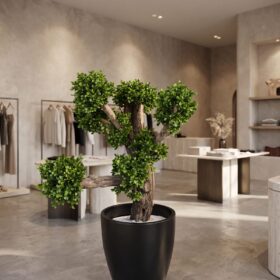
The simplest answer is usually a single tree built tall enough to matter. Because we fabricate in our own workshop in Jdeideh, height is a decision rather than a limitation — a custom artificial tree is built around a real preserved trunk to whatever height the space asks for, with the canopy width set to the plan rather than to a catalogue.
In a stairwell, the useful trick is to set the canopy at the height of the first landing, so the foliage is close enough to touch as you climb and the trunk gives the lower level something to read. In a double-height living room the canopy usually wants to be higher — in the upper third of the void, so it is in the frame when you look up from the sofa.
A green wall that climbs with the stair
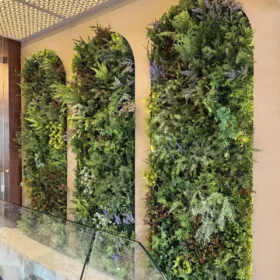
Where a long blank wall rises beside the flight, foliage panels can follow it. An artificial green wall on a stairwell wall is one of the few installations that improves as you walk past it, because your distance from it changes continuously. The edge where the panelling stops is the detail that matters most. A green surface that ends in a straight horizontal line halfway up a wall looks cut off; ending it along the diagonal of the stringer, or carrying it to a ceiling or beam, makes it read as a deliberate surface rather than a patch.
Something suspended from above
Trailing foliage hung from the upper level fills volume without taking any floor. It works especially well over a stair void, read from below as a canopy and from the landing at eye level. Fixing is the whole job: the load goes into the slab or into steel, never into plasterboard, and lengths are set on site with someone standing at the bottom.
Plan the access before the install, not after
The question nobody asks until later is how you will reach the piece in two years. Artificial greenery asks for almost nothing, but it does collect dust, and a canopy four metres above a staircase is not somewhere to put a ladder. Stairs are the worst surface to work from: uneven footing, a drop on one side, no flat base for a tower.
So the access route is part of the design. A canopy at landing height can be dusted from the landing. A green wall within reach of the flight can be wiped section by section. A suspended piece should hang on a fixing that lets it be lowered. Decide this on paper and the maintenance problem never arrives.
Light, glass and weight
Double-height spaces almost always come with tall glazing, which is why they feel good — and it means a piece indoors can sit in direct sun for hours a day. We use anti-UV foliage in those positions even though the piece is technically inside: a canopy against a south-facing window is in the same light as a terrace.
Weight deserves the same attention. A tall tree is a lever: the taller the trunk, the more a knock at the top wants to move the base. Beside a staircase, where people pass close, the base needs real mass and a planter sized for stability rather than for looks alone. Getting the planter right is what keeps a tall piece feeling solid in a space people move through. For lobbies, stair atriums and other shared voids, we handle this as part of a full commercial installation, including the fixing details and the install sequence.
Common questions
How tall can an artificial tree be made?
Trees are built to the size of the space, so the limits are the ones your building sets: ceiling height, the width the canopy can open to, and the door, stair or lift the piece must pass through. We ask about access before height, and large pieces are often delivered in sections and assembled on site.
Is a green wall or a tree better for a stairwell?
It depends on which surface is empty. If it is the wall running up beside the flight, panels are the natural answer. If it is the air in the middle of the void, a tall tree or a suspended piece fills it and a wall will not. Narrow stairwells usually want the wall treatment, because a canopy would be in the way.
How long does a custom piece take?
Custom trees are built to order in Jdeideh and normally take around 20 to 25 working days, with delivery and installation anywhere in Lebanon. Stock pieces from the showroom are quicker, and sometimes the better route for a modest void.
Bring us the height and we will work from that
If you have a stair void or a double-height wall you have never known what to do with, a photograph from the bottom, one from the landing and the floor-to-ceiling measurement are enough for us to suggest something concrete. Send them on WhatsApp or through our contact page, or come and see the pieces in person at the showroom in Jdeideh, facing St. John Greek Orthodox church.