

Uncategorized
Cafés With a Small Footprint: Vertical Greenery Instead of Floor Space
Every square metre of a small café is already spoken for. The counter takes a strip along one wall, the machine and fridge the depth behind it, the door needs a swing, and what is left has to hold tables. In a room of thirty or forty square metres, a floor planter the width of a chair is not a decorative choice — it is a seat, and over a year a lot of covers.
That is the arithmetic behind most of the small-café work we are asked to do: the owner wants the room to feel planted and has no square metre to give it. The answer is almost always to stop thinking about the floor and look at the walls, the shelf line and the ceiling.
Why floor plants fail in a tight room
Pots in a small café go wrong for reasons that have nothing to do with how they look on day one. They get moved: a pot in a narrow room sits in the path of someone carrying a tray, so it is nudged half a metre left, then back, then into a corner where nobody sees it. They get damaged, too — chair legs, mop handles and delivery crates all land on the same floor, and foliage at ankle height takes more abuse in a café than anywhere else.
Most of all, they sit below the eye line. A seated customer’s eye runs along a band one to two metres off the floor — the counter face, the wall behind the banquette, the shelf above the machine. A plant at knee height is outside that band: it costs a seat and does not do the job you bought it for.
The three surfaces worth using instead
The wall behind the seating
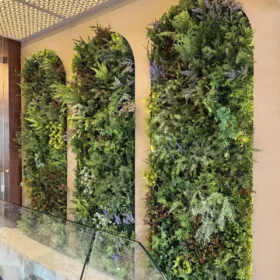
The most effective move in a small café is a green panel on the wall your seated customers face or lean against. It takes no floor area, fills the band people actually look at, and photographs well — which matters more than most owners expect in a café that lives partly on Instagram.
It can be a full wall, or a band — a strip a metre or so high running the length of the banquette, plaster above left clean. A band often reads better in a low-ceilinged room: it keeps the eye horizontal and makes the space feel longer. Our artificial green walls are built as panels in our Jdeideh workshop and fixed to a frame, so the shape follows the wall you actually have, including around sockets, pipework and a service hatch.
The gap above the counter and the shelf line
Above the machine, above the pastry case, along the top of the back bar — there is almost always a dead strip holding nothing but a box of cups. Trailing foliage there softens the busiest, most reflective part of the room, exactly where customers stand to order. It also keeps greenery out of reach of chairs and mops, which is why it still looks right years later.
The ceiling and the window reveal
A frame hung above a communal table, or foliage along the top of a shopfront window, adds the feeling of being inside something planted without touching the plan at all — and with a glass frontage it is visible from the street, giving someone walking past a reason to look twice.
What vertical greenery asks of you in a café
Fixing method. A panel in a café is mounted on a frame, not glued to plaster, and it needs to come off: walls behind a counter get repainted, pipework opened, a fridge replaced. We build panels that can be unscrewed and refitted rather than demolished.
Distance from heat. Foliage directly above a grill or an oven mouth is the one placement we will argue about — not because it melts, but because grease in the air is far harder to clean off foliage than ordinary dust. We set panels back from the cooking line.
Access for cleaning. A panel is low maintenance, not no maintenance. Putting it where someone can reach it with a feather duster, rather than above a fixed bench at three metres, is a design decision.
When a tree still earns its space
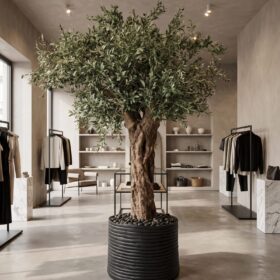
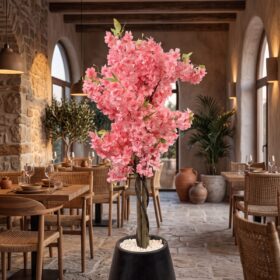
One exception is worth making. If the café has a corner that cannot hold a table anyway — an awkward triangle beside a door, a dead end past the toilets — a slim tree there costs nothing in covers and gives the room a vertical anchor no panel can. A narrow custom artificial tree on a preserved natural trunk, with a canopy sized to clear the ceiling and not the walkway, is the piece for that corner; built to measure, those take around 20 to 25 working days.
What does not work is the compromise: a pot pushed against a wall mid-seating, blocking a chair and half hidden behind a table. Either the corner is genuinely unusable, or the greenery belongs on the wall.
FAQ
How much wall do I need for a green panel to look intentional?
Less than most people assume, as long as the shape is deliberate. A clean band or a defined section reads as design; a small isolated square reads as a sample. If the wall is narrow, go taller rather than wider.
Will foliage above a coffee machine get ruined by steam?
Steam alone is not the problem; airborne grease from cooking is. Above an espresso machine with no frying nearby, a panel is fine with normal dusting. Above a grill or fryer we keep it back and plan around that.
Can a panel be removed if I renovate or move?
Yes — if it was built to be. Panels on a frame can be unscrewed, taken down and refitted elsewhere. Say at the quoting stage that you may move, because it changes how we build the frame.
Come and see it before you commit
With a tight café plan, the quickest way forward is a photograph of the room with the counter in frame and a rough ceiling height — usually enough for us to say which surface to use. You can also walk into the showroom in Jdeideh, facing St. John Greek Orthodox church, and put your hand on the panels before deciding anything.
Everything is made in our own workshop in Jdeideh, Metn, and we deliver and install nationwide. Message us on WhatsApp with your photos, or reach us through the contact page. For food and drink spaces, our restaurant greenery and vertical garden pages show more of what we build.