

Blog
Storing Seasonal Greenery and Event Pieces Between Uses
A seasonal arch that looked expensive in December is often worth nothing by the following November, and rarely because it was badly made. It was used once, then put away badly — folded into a bag, pushed under a staircase, stacked beneath something heavy for eleven months. Event and seasonal pieces spend most of their lives in storage, so storage is where their lifespan is decided.
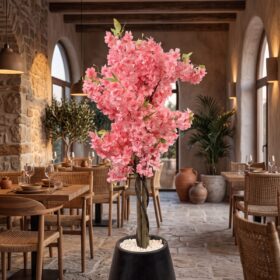
If you run a venue, a restaurant or an events company in Lebanon, you probably own more greenery than you think: garlands from an opening, blossom branches from a menu launch, a pair of potted trees that move between terrace and stockroom twice a year. Here is how to put it away so it comes back out looking the way it did.
What actually damages a piece in storage
Four things, in rough order of how often we see them.
Compression
Artificial foliage is shaped: every leaf sits at an angle somebody set by hand, and the stems holding those angles have a memory. Weight on a canopy flattens that memory permanently if it stays long enough. A crushed canopy, not fading, is the most common reason a stored piece looks tired when it reappears.
Heat
A closed storeroom under a roof, or a container on a rooftop, reaches temperatures in a Lebanese August that no display space does. Sustained heat softens stems and adhesives, which is how branches that were tight in May come back loose in October. Choose the coolest storage you have, even if it is less convenient.
Damp
Basements and ground-floor stores near the coast hold humidity all winter. Foliage itself does not rot, but anything organic in the piece can take on a smell, and metal fixings can leave rust marks. Damp also turns a thin film of dust into a stain you cannot brush off.
Dust left to settle
Putting a piece away dirty guarantees it comes out dirtier. Dust that sits undisturbed for months, especially in humidity, bonds to the leaf surface instead of resting on it.
Before it goes away
Ten minutes of work at pack-down saves an hour at set-up, and sometimes saves the piece.
- Clean it first. A dry dust with a soft brush or a hairdryer on cool is enough for most foliage. Let anything you have wiped dry fully before it is enclosed.
- Photograph it installed. One wide shot and two close-ups. When it goes back up next season, often with different staff, the photo beats any note.
- Strip out what does not keep. Batteries out of lit elements, dried material removed, tape and cable ties cut off rather than left to mark the stems.
- Label the side of the box, not just the lid: what is inside and which way is up.
Packing without crushing
The principle is the same throughout: let the foliage take the space it wants, and carry the weight somewhere else.
Branches and garlands should be coiled loosely, never folded. A fold becomes a permanent kink; a wide coil spreads the bend along the whole length. Lay coils flat in a shallow box rather than on end.
Smaller trees and bushes travel best upright, in a box tall enough that nothing touches the lid. Lift the branches gently upward first so the canopy closes like an umbrella instead of being pressed sideways. If a tree must lie down, support the canopy on something soft and stack nothing above it.
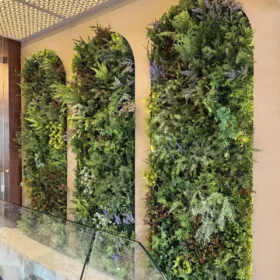
Green wall panels stack face to face in pairs, with card between each pair. Face to back, the rigid base of one panel presses into the foliage of the next. Keep stacks short and on a pallet or shelf, never on a floor that might take water.
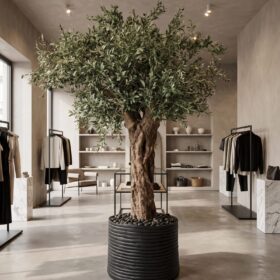
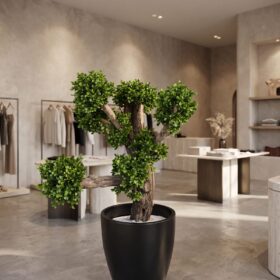
Large custom trees are usually better left standing than dismantled. Where a piece was built for a specific room, moving it into a store often costs more in handling than leaving it in place. Our custom artificial trees are built around preserved natural trunks, and the trunk and base are the parts that do not forgive bad handling — ask us before moving one rather than after.
Where to put it
In order of preference: a shaded, ventilated internal room on an upper floor; a cupboard or mezzanine inside the venue; a ground-floor store with the stack raised off the floor. Last resort is anything with a metal roof or direct afternoon sun. A dust sheet is better than sealed plastic, which traps moisture against the foliage.
Pieces that move seasonally are worth designing for that life from the start. Planters on castors, panels sized to fit through the door they will actually travel through, and modular sections rather than one fixed structure all decide whether a piece gets reused or quietly becomes storage. We size custom planters and green wall panels to the space and to the route in, which for venues that reset several times a year is the most useful conversation we have.
Bringing it back out
Unpack a day early if you can. Boxed foliage needs time and handling to recover its shape: lift each branch, rotate stems so leaves face outward and slightly down, and fill the gaps that appear where the canopy was compressed. Dust again once it is standing, since boxes shed too. A piece that comes out thin or discoloured on one side can usually be refoliated rather than replaced — worth asking about before you write it off.
FAQ
Can artificial greenery be stored outdoors under a cover?
Not well — even covered, an outdoor stack gets heat, condensation and insects. Keep anti-UV outdoor foliage for pieces that genuinely live outside.
Do you repair event pieces that were stored badly?
Often, yes. Crushed canopies can be reshaped and refoliated, loose branches re-fixed, panels re-edged. Send photographs and we will tell you honestly whether repair is worth it.
Can you build pieces specifically to pack down?
Yes. Modular panels, sectional garlands and demountable structures are normal requests — a design decision made at the quoting stage rather than added later.
Talk to us about a piece you already own
We fabricate everything in our own workshop in Jdeideh, Metn, and deliver and install nationwide — which also means we see what Lebanese storerooms do to greenery. If you have seasonal pieces coming out of storage and are unsure whether to refresh or replace them, send a few photographs on WhatsApp or through our contact page. The showroom in Jdeideh, facing St. John Greek Orthodox church, is open if you would rather see how pieces are built first.