

Blog
What Building Greenery for Lebanese Hospitality Taught Us
Hospitality taught us more about building greenery than any other kind of work, and almost none of what it taught us was about plants. Restaurants, hotels, beach clubs and lounges all put the same unusual demands on a piece: it has to be beautiful on opening night, and it has to still be standing, clean and unembarrassing after a thousand services, a few hundred staff shifts and at least one fire-alarm evacuation.
Decorative work for a home is judged once. Hospitality work is judged every evening by a room full of people paying to be there. That difference has quietly reshaped how we build in the Jdeideh workshop — the frames, the fixings, the weighting, even the way we record a foliage mix so it can be repeated two years later.
Lesson one: the room is cleaned at midnight by someone in a hurry
The person who interacts most with greenery in a venue is not the designer or the guest. It is whoever closes the room at one in the morning with a mop and a limited amount of patience. If a planter cannot be slid aside, it gets shoved. If foliage hangs into the sweep line, it gets pushed back with the mop handle, night after night, until the branches sit at an angle nobody intended.
So we now ask about the cleaning routine before we finalise a shape. Lower foliage is lifted clear of the floor sweep. Planters in high-traffic positions are specified so two people can move them without taking the tree out first. Against a wall that gets wiped down, the rear branches stay short. None of this shows in a photograph, and all of it decides whether the installation still looks like the render a year on.
Lesson two: nothing stays where you put it
A dining room is reconfigured constantly — a party of twenty on Saturday, a corporate lunch on Tuesday, the whole floor cleared for a private event. Greenery that was positioned perfectly gets moved, and whatever is easiest to move is moved most often.
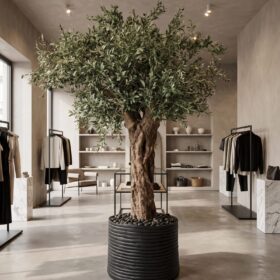
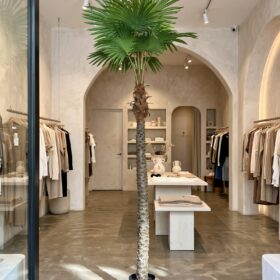
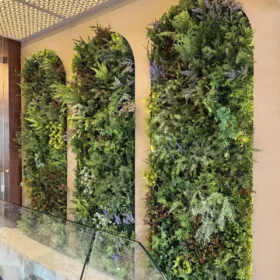
That reality split our hospitality work into two categories. Fixed pieces — green walls, the structural tree in the atrium, a planted divider that defines circulation — are built to be genuinely fixed and weighted accordingly. Everything else is built knowing it will travel: balanced so it does not tip when dragged, with a base that will not scratch a tiled or timber floor, and a canopy that clears a standard doorway. The planter is doing half of that job, which is why we size and weight it for the room rather than fitting whatever box is in stock.
Lesson three: the air near a kitchen is not the air in a lobby
Venues have microclimates, and they are harsher than most interiors. Airborne grease from an open kitchen turns ordinary dust into a film that does not brush off, and a terrace in Beirut adds sun, salt and traffic grime on top of that.
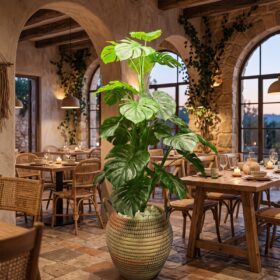
Two things follow. First, we use anti-UV outdoor foliage for anything on a terrace, a pergola or a rooftop, including pieces that are nominally under cover — covered in Lebanon still means several hours of direct afternoon sun. Second, we talk openly about washability. A piece near a kitchen line should be one that can be wiped or rinsed, not one that only tolerates a soft dusting. Choosing the material for how it will be cleaned is a decision best made before fabrication, not after the first greasy season.
Lesson four: you will be asked to match it later
Hospitality clients expand. A second branch opens, a terrace gets enclosed, a damaged piece needs replacing before a busy weekend — and the request is always to match the first one.
That is only possible if the original was recorded, so we keep the specification of what we build: trunk, frame, foliage mix, proportions, planter dimensions. Because pieces are fabricated in our own workshop rather than bought in from a shipment, matching means remaking to the same spec instead of hoping a similar product is still available. It is the practical argument for an in-house factory that most people only appreciate on their second order.
Lesson five: the venue cannot close for you
Almost every hospitality install happens in a gap — after close, before a soft opening, between a Sunday lunch and a Monday dinner. That constraint is not negotiable, so the planning moves upstream: access route measured in advance, pieces built to pass through the actual door rather than the one on the drawing, fixings chosen for the wall that is really there, foliage finishing done on site so nothing arrives crushed.
Most of what makes an overnight install calm was decided weeks earlier in the workshop. That is the whole lesson of commercial work: the install is the easy part if the build anticipated it.
What it changed about how we design
The net effect is a bias towards fewer, better-placed pieces. Three well-sized installations built for a room’s real conditions will outperform a dozen that are all slightly in the way. Hospitality rewards restraint, because every object in a working venue eventually has to justify the space it takes and the cleaning it demands.
Frequently asked questions
Can artificial greenery handle an open kitchen or shisha area?
Yes, provided it is specified for it. Choose foliage and finishes that can be wiped or rinsed, and place pieces outside the direct path of extraction where possible. Tell us about the kitchen or smoking area at the briefing stage and we will build accordingly.
How long does a custom piece take for a venue opening?
Custom trees are generally around 20 to 25 working days from approval. Ready-made pieces from the Jdeideh showroom are much quicker, which is why opening timelines often mix the two.
Can you match pieces for a second branch later?
Yes. We keep the build specification, so a later piece can be made to the same trunk character, foliage mix and proportions rather than approximated.
Do you install outside Beirut?
Yes — we deliver and install nationwide, and most hospitality installs are scheduled around the venue’s closed hours.
Talk to us about your venue
If you are fitting out a restaurant, hotel, cafe or lounge, the useful conversation starts with the room and its routine, not with a catalogue. Send photographs or a plan on WhatsApp, or use the contact page, and we will tell you honestly what will hold up and what will not. You are also welcome at the showroom in Jdeideh, facing St. John Greek Orthodox church, to handle the work before you commit to anything.