

Blog
Texture Mixing: Foliage Types That Look Convincing Together
Stand close to a green wall that does not quite work and you will usually find the same leaf repeated a few thousand times. The colour may be good, the panels may be level, the coverage may be dense — and it still reads as a manufactured surface rather than planting. The problem is not quality. Nothing in nature grows in a single texture, and the eye knows it long before the brain finds the words.
Texture is the least discussed decision in artificial greenery and one of the most decisive. Get the mix right and a composition holds up at arm’s length. Get it wrong and no leaf count rescues it.
What “texture” actually means in a foliage mix
When we talk about texture with a client in the Jdeideh showroom, we are really talking about four separate things, and they can be adjusted independently:
- Leaf size. The span from a boxwood pip to a fiddle-leaf blade. Size differences are what the eye reads first, from across a room.
- Surface finish. Matte, satin or glossy. A rubber plant leaf throws a highlight; an olive leaf absorbs light and goes silver-grey at the edge of the beam.
- Edge and shape. Rounded, lance-shaped, lobed, serrated, needled. Edges set the rhythm of the silhouette.
- Density and depth. Whether light passes through the foliage or stops at the front face. This is the one most people never consider, and the one that separates a wall with depth from a wall that looks printed.
A convincing mix varies at least three of the four. A mix that varies only colour — two greens, same leaf, same finish — almost never convinces.
One dominant foliage, one supporting, one accent
The simplest structure that works, whether you are building a green wall or grouping trees in a lobby, is a hierarchy rather than a blend.
Choose one foliage to carry the composition — the thing a visitor would name if asked what they were looking at. Add a second that differs clearly in leaf size and sits quieter, filling between and behind the first. Then add a small amount of a third that is deliberately out of step: a needled or trailing element, something with a different edge, something that catches light when the other two do not.
The common mistake is to treat the three as equals. Split evenly they compete, and the result looks like a sample board. The accent should be scarce enough that a visitor notices the effect without locating the cause.
Texture in a green wall versus texture in a tree grouping
The two cases pull in opposite directions.
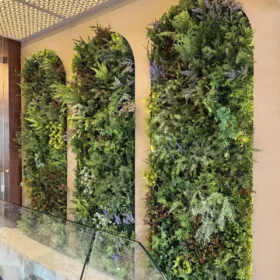
A green wall reads as a single flat plane, so its texture has to be built in — varied leaf sizes, some foliage set deeper than the front face, trailing elements breaking the top and bottom edges so the panel does not announce where it stops. On artificial green walls we mix leaf types across each panel and then again across the panel joins, so the grid never becomes legible. A wall made of one foliage at one depth will look like what it is from three metres away.
A tree grouping has depth already. Here the risk is the reverse: too many different foliages in one corner and the group stops reading as planting and starts reading as a display. Two or three distinct species, with one clearly dominant, is usually the limit before a grouping loses coherence.
Mixes that work in Lebanese interiors
Some combinations come up again and again in the pieces we build, because they do something specific:
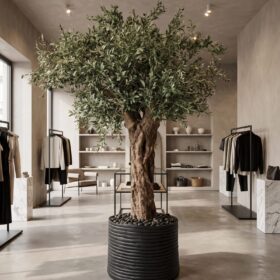
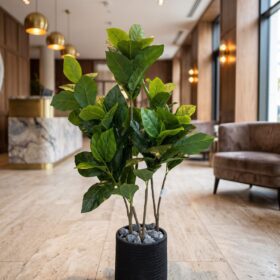
Olive with ficus. Small silver-grey leaf against a broad matte green one. The olive supplies character and the ficus or fiddle-leaf supplies mass, which is useful in a corner that needs filling without a second sculptural tree competing for attention.
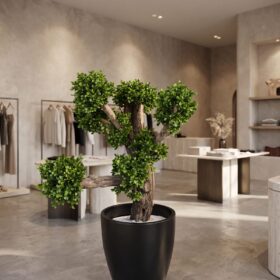
Boxwood base with fern and eucalyptus. A dense, tight-leafed field broken by two looser, lighter textures. This is the backbone of most green walls that still look right up close, because the fern fronds introduce transparency the boxwood cannot.
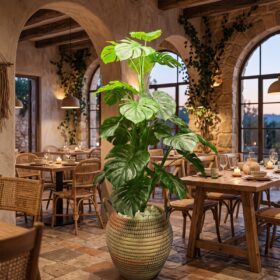
Palm with low broad-leaf planting. Long, hard, linear fronds above soft rounded foliage at the base. Outdoors — terraces, pool decks, villa entrances — the contrast also happens to be practical, since both can be built in anti-UV foliage that holds colour through a Lebanese summer.
What to avoid
Three failures account for most of the texture problems we are asked to fix.
The first is uniform gloss. Several foliage types with a shiny finish, lit from one direction, produce a sheet of identical highlights that reads as plastic however good each leaf is.
The second is mixing by colour instead of by form. Three greens of the same leaf shape and size give variation a camera picks up and a person does not.
The third is scale mismatch with the room. A fine, small-leafed mix in a double-height stairwell disappears; a mix of very large leaves in a narrow corridor reads as oversized and slightly menacing. Texture has to be chosen for the viewing distance, not on a workshop bench — one reason we build to the dimensions of a specific space rather than a catalogue size.
FAQ
How many different foliage types should a green wall have?
Enough that no single leaf dominates the surface, with one type clearly leading. For most walls that means a dense base foliage plus two or three contrasting types. Beyond that the mix tends to look busy rather than natural.
Can I mix textures on a single tree?
Within reason. A tree should read as one species, but a preserved natural trunk already supplies a strong contrasting texture against the canopy, and varying leaf size within the canopy — larger towards the interior, finer at the tips — is part of what makes a built tree convincing.
Can I see foliage samples before deciding?
Yes — this is the part worth doing in person. Our showroom in Jdeideh is in the same building as the workshop, so you can handle the actual foliage, see it under light, and compare finishes side by side before anything is built.
Talk it through with us
Planning a wall, a grouping or a single large piece and unsure which foliages belong together? Send us a photo of the space and tell us the viewing distance. We make everything in our own workshop in Jdeideh, Metn, to any size, and deliver and install nationwide.
Message us on WhatsApp or use the contact page — or visit the showroom in Jdeideh, facing St. John Greek Orthodox church, and look at the foliage yourself.