

Uncategorized
How to Judge the Quality of an Artificial Tree Before You Buy It
Six things tell you most of what you need to know about an artificial tree. Five you can check with your hands; the sixth is a question you have to ask out loud. None of it requires any knowledge of greenery — only the willingness to touch something before you pay for it.
Most buyers do the opposite. They approve a photograph, a height and a species, then find out what they bought a year later, when branches have begun to droop mid-canopy or the leaves facing the window no longer match the ones facing the wall. Here is what to check instead, in the order that tells you the most, fastest.
1. Start at the trunk, not the leaves
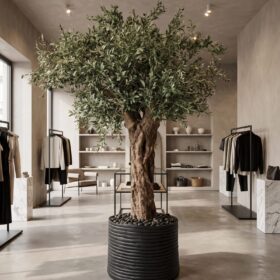
The trunk sets the first impression and is the hardest part to fake. Put your hand on it. A moulded trunk repeats: run your palm along it and the same knot, split or hollow usually appears again further up, with a seam line somewhere down one side. That repeat is what the eye catches before the brain works out why.
A real preserved trunk cannot repeat, because it grew. Splits open where the wood moved, the taper is uneven, and the bark changes character between the base and the first fork. On our artificial olive trees that is the main reason a piece still holds up at close range in a lobby or a living room.
Then look at where the trunk meets the foliage. That join is where inexpensive trees give up: a bare stub, a visible collar, a jump from wood to plastic with nothing bridging it.
2. Follow one branch to where it joins
Pick a branch about halfway up and move it gently. You want it rigid where it meets the trunk and flexible at the tip. If the whole branch rotates in its socket, or feels springy at the base, it is carrying its weight on a push-fit plastic fitting — the part that slowly surrenders to gravity. Drooping canopies are almost never a foliage problem; they are a joint problem. Ask what the internal structure is: a branch bolted or welded into a steel frame will sit where it was placed in five years, and one pushed into a moulded collar will not.
3. Look at the foliage from three distances
This is the test most people skip, and it takes thirty seconds.
- From across the room — silhouette and density. Can you see the wall through the middle of the canopy? A thin canopy reads as artificial from the furthest point in the room, which is where most people see it.
- At arm’s length — colour variation. One flat shade of green is the clearest giveaway there is; real foliage carries several tones at once, newer growth lighter than older.
- Up close — leaf edges, veining and undersides. On most species a leaf is noticeably paler underneath than on top. Cheap foliage is printed the same on both faces.
4. Ask what the foliage is rated for
Indoor foliage put on a terrace in Lebanon does not last a summer. It goes pale, then chalky, then brittle, and cleaning does not bring it back. If the tree is going anywhere the sun reaches — balcony, driveway, pool deck, rooftop — ask directly whether the foliage is anti-UV and meant for outdoor use.
How the answer comes back matters more than the answer. “Anti-UV outdoor foliage — here is the same leaf in the indoor version” is a different conversation from “it should be fine outside.” Our custom trees are specified indoor or outdoor before anything is built, because that choice changes which foliage goes on the frame.
5. Try to move the base
A large tree is top-heavy by nature. Everything that makes it look good — height, long branches, a wide canopy — works against it the moment someone brushes past or a door lets in a gust. Push the top lightly with one finger and watch the base. If it lifts, the weighting is wrong for the canopy.
Check the planter too. A well-built piece has a planter sized to the tree it holds, not whatever container was in stock. If you are matching an existing interior, custom planters solve the proportion and the ballast together.
6. Ask where it was made — and who can fix it
This is the question your hands cannot answer. A tree that arrived in a shipping container is whatever was inside the container; if a branch breaks or the canopy thins, there is nobody to go back to. A tree built in a workshop can be re-foliaged and repaired years later, because the people who assembled it still have the frame and the same foliage on the shelf. It is why we keep our fabrication workshop and showroom in Jdeideh in the same building — you can see the finished pieces and the unfinished ones behind them in one visit.
The one question that reveals the most
Ask: “Can you make this one thirty centimetres taller, with a narrower canopy?” A maker answers with a lead time and a question about your ceiling. A reseller tells you what is in the catalogue. Both answers are useful — you simply want to know which you are dealing with before you decide.
Questions buyers ask us
Does a heavier tree always mean a better tree?
No. Weight in the right place — base and frame — is a good sign; weight from a planter packed with loose filler under a light frame is not. Push-test the top rather than lifting the bottom.
Can I tell anti-UV foliage just by looking at it?
Not reliably. Two leaves can look identical in a showroom and behave completely differently after one Lebanese summer, so ask — and have it specified on the quote.
Is a custom tree always higher quality than a ready-made one?
Not automatically — a well-made stock piece beats a badly made custom one. What custom buys you is fit: the exact height, canopy width and planter for your space, built to order in roughly 20 to 25 working days.
Bring your measurements
If you are weighing up a piece — ours or anyone’s — send us a photo of the corner and the ceiling height, and we will tell you plainly what to look for. We fabricate everything in our own workshop in Jdeideh, Metn, deliver and install nationwide, and are rated 5.0 on Google.
Message us on WhatsApp, use the contact page, or come and put your hands on a few trees at the showroom in Jdeideh, facing St. John Greek Orthodox church.