

Uncategorized
Fiberglass, Steel or Aluminium Planters: Choosing by Weight, Climate and Budget
The planter is usually the last decision in an order and the first one people regret. The tree gets weeks of attention; the container it stands in is picked from a photograph, by colour, in about four minutes. A year later it is the planter that has bled rust onto pale stone, cracked where a trolley clipped it, or proved impossible to shift when the furniture moved.
Three materials cover almost everything we fabricate in our Jdeideh workshop: fiberglass, steel and aluminium. None is simply the best. They fail in different ways, and the useful question is not which is strongest but which suits your floor, your exposure and the piece it has to hold.
Start with the floor, not the finish
Before colour or shape, work out what the planter will weigh in position — the shell, plus the ballast that keeps a tall tree stable, plus the tree. A large piece can end up heavier than the armchair beside it. Then ask three questions about the room:
- What is underneath? A ground-floor tiled lobby will take almost anything. A balcony slab, a rooftop, a mezzanine or a raised timber floor will not, and that is a structural question rather than a decorative one.
- How does it get in? Stairwells, lift doors and landing turns decide more planter dimensions than taste does.
- Will it ever move again? If two people need to reposition it for cleaning or a new layout, that rules a lot out immediately.
Fiberglass: shape freedom at low weight
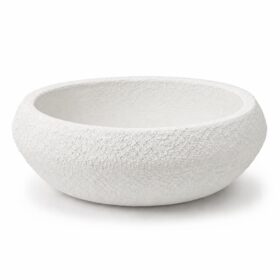
Fiberglass is the workhorse of large decorative planters for one structural reason: it is formed in a mould, so the wall can be thin and strong at once. That buys two things metal struggles to give. The first is weight — a tall fiberglass trough is light enough to carry up a staircase before it is filled. The second is geometry: curves, tapers, bowls and organic shapes, with a finish that can be smooth, matte, stone-textured or colour-matched to a paint or tile.
It also has no interest in water. Nothing in it corrodes, so rain, irrigation and salt-laden air leave it alone — which is why it is a safe default on terraces and around pools. Its weakness is impact: metal dents, fiberglass can chip or crack. The consolation is that a crack is repairable in place, where a deep dent in a powder-coated panel usually is not.
Steel: mass, sharp edges and the rust question
Choose steel when you want what only mass and rigidity give — long straight runs that must stay flat, crisp architectural edges, a planter doubling as a bench or barrier. Steel holds these without flexing, and its own weight adds stability in an exposed spot.
The cost is corrosion management, decided at the drawing stage rather than later:
- Indoors, powder-coated mild steel is comfortable and long-lived. Very little is attacking it.
- Outdoors near the coast, salt finds every scratch and every weld. Steel can be protected, but the protection becomes something to inspect rather than forget.
- Corten and other weathering steels form the warm rust patina people like in photographs — and that patina runs in rain, staining limestone, pale travertine and light concrete beneath it. Lovely over gravel or dark tile; a problem over pale stone.
Aluminium: light metal for terraces and rooftops
Aluminium sits between the two. It gives the flat planes, hard edges and powder-coated finish of metal at a fraction of steel’s weight, and it does not rust. For rooftops, balconies and anywhere the structure has a weight limit but the design calls for a crisp metal box, it is often the only honest answer. Two caveats: it is softer, so it dents more readily under a real impact, and per kilo it is a more expensive metal — on a protected ground-floor site you may be paying for lightness you do not need.
Where the money actually goes
Material is only part of what a planter costs to make; the rest is labour and finish. A fabricated metal planter is cut, welded, ground, primed and coated, and every step is handwork, while a moulded fiberglass shell front-loads its effort into the mould. Neither is priced by weight — both are priced by hours and by how complicated the finish is.
If the budget is tight, simplify the geometry and the finish before you downgrade the construction. A well-built planter in the right material will outlast an elaborate one cheapened where it matters — the base, the drainage detail and the internal liner. Those details are on our custom planters page.
Match the planter to the tree, not just the room
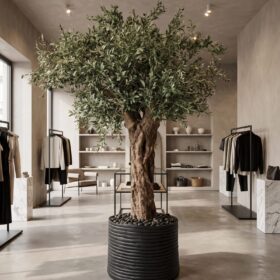
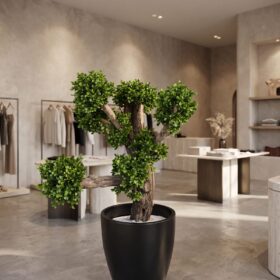
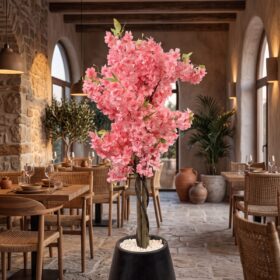
A planter has to be deep and wide enough for the tree’s base plus enough ballast to stop a heavy canopy making the whole thing top-heavy. A two-metre olive in a shallow designer bowl will sit badly, however good the bowl is. When we build a custom artificial tree, the planter is sized around the finished piece rather than chosen afterwards — which is the main reason to settle both together.
Common questions
Which material should I use on a seafront terrace?
Fiberglass or powder-coated aluminium. Both are unbothered by salt air. Untreated or lightly coated mild steel is the one to avoid there, and weathering steel will stain pale paving below it.
Is a lightweight planter stable enough for a tall tree?
Yes, because stability comes from the base design and the ballast inside, not from the shell. We weight large pieces internally so the centre of gravity sits low; the shell’s job is to hold the shape and the finish.
Can you make a planter in a specific colour or size?
Yes. Everything is fabricated in our own workshop in Jdeideh, in any size, finished to a colour or texture you specify — including matching an existing planter, a floor tile or a wall paint.
Can an existing tree be moved into a new planter?
Usually. Send photographs with the base measured and we can say what will fit and whether the piece needs re-weighting — the same check we run on outdoor landscaping where several planters must read as a set.
Talk it through before you choose
If you know the space but not the material, send a photograph of the corner or terrace, the rough size you want, and what is underneath the floor. That is enough for us to say which of the three makes sense and which to rule out. Message us on WhatsApp or through the contact page, or visit the showroom in Jdeideh, facing St. John Greek Orthodox church, to handle all three before deciding.