

Uncategorized
Bougainvillea, Lemon and Fruit Trees: Mediterranean Character Indoors
Ask someone to picture a Lebanese courtyard and the plants arrive in a fixed order: an olive somewhere in the middle, bougainvillea spilling over a wall, and a lemon tree close enough to the kitchen door that somebody can reach it. The olive carries dignity. The other two carry something harder to name — the sense that people live here, cook here, sit out here in September. It is why clients who have settled on an olive tree still ask what else belongs in the room, and why the answer is so often a flowering climber or a citrus.
Why real bougainvillea and lemon rarely work indoors
Both plants are built for conditions a Lebanese interior cannot provide. Bougainvillea wants full, direct sun, heat and a dry root run; put it in a shaded courtyard or behind glass and it produces leaves and almost no colour, which is the opposite of the reason anyone wanted it. A real lemon needs several hours of unfiltered sun to set and hold fruit, and it reacts to being moved indoors by dropping leaves first and flowers second.
Outdoors in the right spot, both are worth growing. Indoors, or in a shaded corner, they end up as a half-bare plant nobody wants to look at. That is the gap these pieces fill: courtyard character where the courtyard conditions do not exist.
Bougainvillea is a climber, not a tree
This is the single thing that decides whether an artificial bougainvillea looks right. A real one does not stand up by itself. It leans on something, grips it, and spreads along whatever it finds — a wall, a railing, a pergola beam, the top of a gate. Built as a tidy shrub in a round pot, it reads as fake immediately, because the shape belongs to no plant anyone has seen.
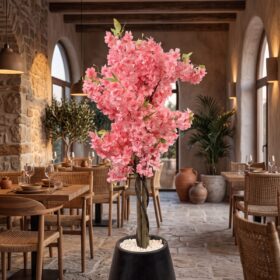
So in the workshop in Jdeideh a bougainvillea is built around the structure it will live on. On a pergola it runs along the beams and hangs between them, heavier where it starts and thinning as it travels. On a wall it climbs off-centre and fans outward. From a raised planter or a balcony rail it cascades, colour low and bare woody growth visible above — and the bracts concentrate where light would hit rather than spreading evenly.
Because bougainvillea almost always belongs outdoors, these are usually specified with anti-UV foliage, made to hold colour through a Lebanese summer rather than go chalky by the second August. Anything on a terrace, roof or exposed facade should be built that way from the start.
Lemon and citrus: the fruit is the hard part
Everyone knows exactly how big a lemon is, how its skin catches light, and how a tree carries fruit at several stages at once. That shared knowledge makes citrus the least forgiving thing we build, and it is why most mass-produced lemon trees give themselves away in a second.
Three things fix it. Fruit sits inside the canopy rather than on the outside of it, partly screened by leaves, found rather than displayed. Density stays low; a real tree in a pot carries far fewer lemons than people expect. And the fruit is not uniform, because no tree ripens on a schedule.
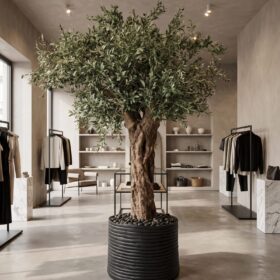
Under that canopy, a custom tree built on a preserved natural trunk does most of the convincing work. Citrus bark is pale, slightly rough and marked where branches were cut back over the years; a real trunk brings that history with it, and the hand that touches it on the way past settles the question before anyone looks up. It is the same principle behind the artificial olive trees we build.
Where these pieces actually go
Restaurant and cafe terraces are the most common home for both. Bougainvillea over a pergola does what a trellis of real planting is supposed to do and usually stops doing by mid-season, and a pair of citrus trees flanking an entrance sets the register before anyone sits down — which is why our restaurant greenery work leans on both.
In homes it is usually a balcony rail or a courtyard wall for bougainvillea, and a lemon beside a dining table or in a kitchen-living corner. Villa entrances take larger pieces well, since outdoor foliage and a weighted planter let a tree stand in wind and sun unattended.
Planters matter more here than people expect. A cascading bougainvillea needs a container with the mass and height to look like it is holding something, and a citrus tree looks wrong in anything too wide for its canopy, so we build custom planters sized to the piece rather than picked off a shelf afterwards.
What to tell us when you order one
Four things get a quote moving: the overall height measured from the floor including the planter, not from the rim; whether it lives indoors or outdoors, since that decides the foliage; for bougainvillea, what it is climbing on — wall, pergola, rail, or nothing, in which case it cascades from a planter; and a photograph of the space taken from where people usually stand. A badly framed phone photo of an empty corner is enough to start.
Custom pieces are built to order in the workshop, which normally takes around 20 to 25 working days. Delivery and installation are nationwide, with weighting and anchoring worked out beforehand for anything standing in a public space.
Common questions
Can an artificial bougainvillea stay outside all year?
Yes, when it is built with anti-UV foliage and mounted properly. The two things that shorten an outdoor piece’s life are interior-grade foliage and a fixing that lets wind work at it — both decided before fabrication.
Do the lemons look real up close?
Close enough that the canopy matters more than the fruit. The pieces that fail have too many lemons sitting on the outside of the foliage. Sparse fruit set inside the leaves holds up at conversation distance, which is the distance that counts.
Can you build a fig, pomegranate or orange tree instead?
Yes. Everything is fabricated in-house to any size, so the species is a brief rather than a catalogue entry. Bring a reference photograph of the tree you have in mind and the room it is going into.
Bring the courtyard inside
If you have a wall, a pergola, a balcony rail or a corner that wants a lemon tree in it, send a photograph and the height you have to play with. Message us on WhatsApp or use the contact page. The showroom in Jdeideh, facing St. John Greek Orthodox church, is open if you would rather see finished pieces first.