

Blog
The Mistakes We See Most Often in Artificial Greenery — and How to Avoid Them
Almost every piece of artificial greenery we are asked to rescue was perfectly well made. The tree is sound, the foliage is decent, the panels are intact — and the thing still looks wrong, or has failed somewhere it should not have. The fault is rarely the manufacturing. It is a decision taken early, quickly, usually before anyone stood in the room with a tape measure. These are the ones that come back to us most often.
1. Choosing the piece before measuring the space
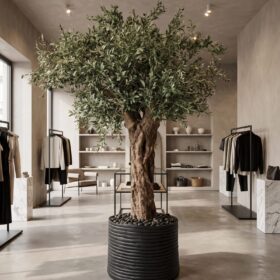
The usual sequence is: see something, like it, buy it, then work out where it goes. That works for a vase. It does not work for a two-metre tree, because a tree occupies volume rather than floor space, and volume is what rooms run out of.
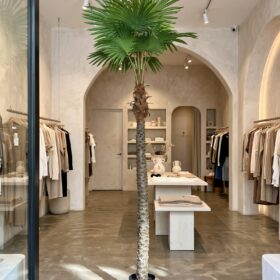
What goes wrong is almost always width, not height. People check the ceiling and forget the canopy. A tree that fits vertically can still push into a walkway, block a shutter, or sit so close to a sofa that the corner seat becomes unusable. Three numbers settle it: ceiling height, clear width at waist level, and the narrowest door the piece must pass through.
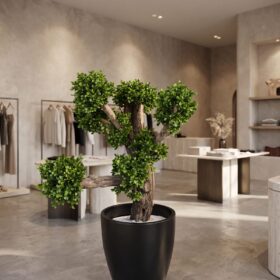
When a piece is built rather than bought off a shelf, those numbers become the brief. We size custom artificial trees in the Jdeideh workshop to the dimensions of the space.
2. Putting indoor foliage outdoors
This is the mistake with the clearest consequences. Standard interior foliage is not made for Lebanese sun, and it does not fail gracefully — it goes pale, then brittle, then dusty-grey, usually on one side only, which looks worse than an even fade. By the time it is obvious, the leaves cannot be brought back.
Anything going on a terrace, balcony, driveway or open courtyard needs anti-UV foliage specified from the start. That cost is decided once; the difference is visible every summer. A piece already outside and fading unevenly can usually have its canopy rebuilt on the existing trunk.
3. Treating the planter as packaging
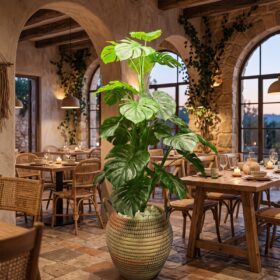
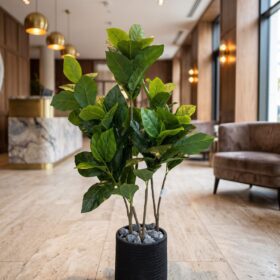
The planter gets chosen last, in a hurry, by colour. Then it arrives and sits at hip height, which is exactly where the eye lands as someone walks past — so it is seen before the foliage is.
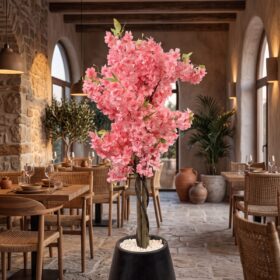
Two failures follow. Visually, a wide canopy over a narrow container looks unstable even when the weighting is sound. Practically, a lightweight planter cannot hold a tall piece anywhere there is a draught, a door or wind; outdoors it is usually the container, not the tree, that gives up first. A planter built for the piece it holds solves both, and it is the cheapest point in a project to get right.
4. One leaf, repeated thousands of times
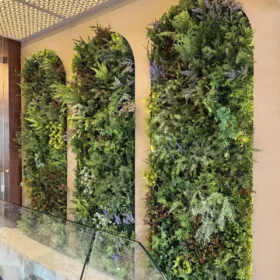
Green walls are where this shows most. A panel built from a single foliage type reads as a manufactured surface no matter how dense or how level it is, because nothing in nature repeats like that. The eye catches the pattern before it registers the greenery.
A convincing wall mixes leaf shapes, sizes and tones: a base foliage for coverage, two or three varieties broken through it, and a slightly different tone where light falls hardest. The same logic applies to a tree canopy — a mix of leaf sizes and a few deliberate gaps read as real, while perfect uniform density reads as product. Our green wall panels are mixed for that reason, and the edges, where panels meet skirting or a sloped soffit, are where the work either holds up or does not.
5. Buying entirely from a photograph
Photographs flatten texture and lie about colour. Foliage that looks convincing on a phone can read plastic in daylight, and two greens that match on screen can clash a metre apart on a wall. The trunk is the clearest case: a moulded trunk and a preserved natural one photograph almost identically and feel nothing alike under a hand. Where you can, touch the bark and bend a branch before committing.
6. Planning the piece but not the installation
A large tree or a full wall has to get into the building before it can look good in it. Lifts, stair turns and door frames decide more than people expect, and a piece that cannot be carried in has to be dismantled and rebuilt on site — possible, but better planned than discovered. Mounting matters as much: a green wall needs to know what is behind the plaster, and outdoors, anchoring and weighting should be settled before delivery day rather than after the first storm.
7. Cleaning it wrong, or not at all
Artificial greenery asks for one thing: dust removal. In Beirut a canopy picks up a grey film within weeks, and grey is what makes a good piece read as fake from across the room. Dry dusting, a soft brush and occasionally a barely damp cloth is the whole routine.
The damage comes from the other direction: household sprays, polish, solvents and pressure washing strip colour and coatings, and that is the one kind of fading nobody can repair. A tired-looking piece is almost always dusty rather than worn out.
What they have in common
Every mistake here is a decision taken in the wrong order: the piece before the space, the planter after the tree, the install after the build. Reverse the order and most of them disappear.
Frequently asked questions
Can a piece that has already faded outdoors be saved?
Often, yes. If the trunk and frame are sound, the canopy can be rebuilt with anti-UV foliage and the piece keeps its character. Full replacement is usually only necessary when the structure itself has been damaged.
How long does a made-to-measure tree take?
Around 20 to 25 working days for a custom tree, depending on size and foliage. Pieces already in the Jdeideh showroom are available immediately.
Is it worth visiting if I already know what I want?
Worth ten minutes of it. Seeing a preserved trunk and comparing indoor against anti-UV foliage in daylight settles most of the questions on this list before anything is built. The showroom in Jdeideh, Metn faces St. John Greek Orthodox church.
Getting it right the first time
Planning greenery for a home, restaurant, office or outdoor space? Send us a photograph of the space and the height you have to work with, and we will tell you honestly what holds up there and what does not.
Message us on WhatsApp or use the contact page. Everything is made in our own workshop in Jdeideh, Metn, to any size, with nationwide delivery and installation — and we are rated 5.0 on Google.