

Uncategorized
Entrances People Photograph: Greenery as a Marketing Asset
Somebody stops just inside your door, takes half a step back, turns their phone sideways and takes a picture. They are not photographing your menu or your reception desk. They are photographing the wall behind the host stand, or the tree beside the stairs — and within a minute that image is on a feed where a few hundred people who have never heard of your business will scroll past it.
That is distribution you did not pay for, and it is almost entirely a design decision made months earlier. Some entrances produce those photographs constantly; most produce none. The difference is rarely budget — it is what the camera was given to look at.
An entrance has two jobs, and most are designed for one
The first job is reassurance: the person arriving should know in a second that they are in the right place and that the place is looked after. Nearly every entrance gets this right.
The second job is to produce an image that travels, and that one is almost never briefed — which is why so many perfectly pleasant lobbies have never appeared in a single customer photograph. A camera does not reward tidiness. It rewards a subject.
What actually makes an entrance photographable
Three things decide it.
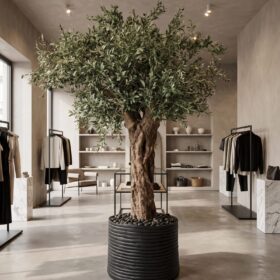
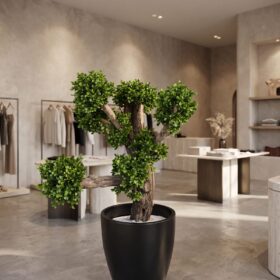
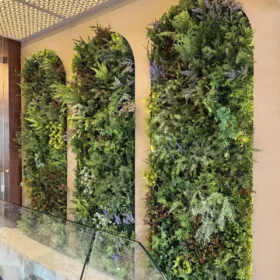
One clear subject. A phone lens flattens a space and loses the edges. Twelve small pots along a skirting board become visual noise; one large olive tree, or one uninterrupted run of green wall, reads instantly even in a badly composed shot. The most common fix we are asked to make is not adding greenery but consolidating it.
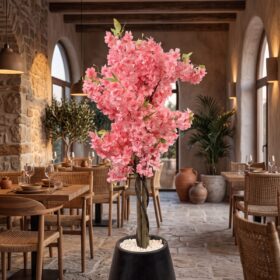
Layering. A flat wall of anything photographs as wallpaper. Something in front of something else — a tree standing a metre clear of a planted wall, a planter breaking the line of a panel run — gives the image depth.
A point of contrast. Green on green on cream is restful to stand in and dull to photograph. A line of warm light across foliage, a pale trunk against dark panels, a smooth planter under rough bark — the lens needs somewhere to land.
Height matters more than width
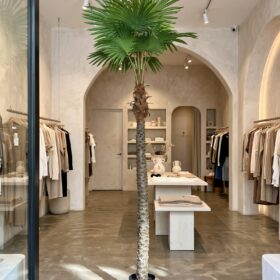
Phones are held upright. A piece that climbs — a tall tree, a panel run taken to the ceiling, a stair void filled with foliage — fits a vertical frame and fills it. A low, wide arrangement ends up as a thin green strip across the bottom of the picture. If an entrance has more height than floor space, which in Beirut it usually does, that is an advantage.
Design for where the camera stands
Before anything is built, work out the two or three places where people actually pause: just inside the door, at the host stand, waiting for the lift, at the foot of the stairs. Those are your camera positions, and the piece should be composed for them rather than for the floor plan. One warning: avoid placing it so the obvious shot points back at a glazed façade — the phone exposes for the daylight and your greenery becomes a silhouette.
Light is half the result
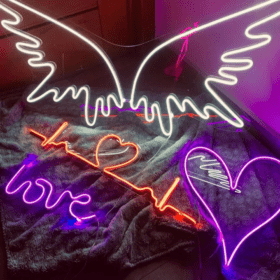
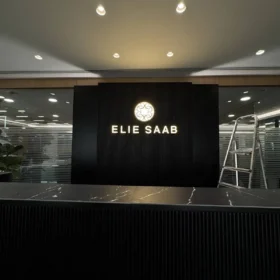
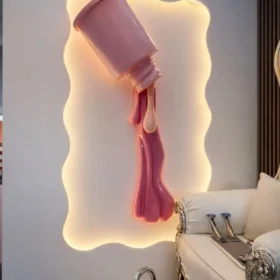
Foliage absorbs light rather than returning it, so a piece in a dim entrance photographs muddy however well it is made. Two reliable answers: wash it from above with warm light, or put a light source inside the frame — a neon script, a backlit wordmark, a run of 3D signage. The second is why custom neon and greenery end up together in so many entrances we build: the green gives texture, the light gives the photograph a reason to exist, and the business name sits inside the shot.
Why these pieces are artificial
An entrance is the hardest place in a building for living plants: draughts every time the door opens, low light, foot traffic, nobody whose job it is to water anything. But the stronger argument is consistency. An entrance that photographs beautifully in its first fortnight and looks tired by month six is worse than no feature at all, because the photographs keep circulating after the room has stopped matching them.
Close inspection is the other consideration. Entrance pieces are seen from a metre away, so this is where preserved natural trunks earn their place: real bark reads as real under a phone held close. For porticos and driveways, anti-UV foliage keeps the colour from drifting over a Lebanese summer.
Five entrance ideas that work in Lebanese buildings
- Narrow lobby, no floor to spare: a panel run of green wall beside the door, taken floor to ceiling. No planter, no lost circulation space.
- Double doors with glass either side: a matched pair of trees — symmetry photographs well and makes a modest entrance feel deliberate.
- Villa entrance or driveway: two outdoor-grade pieces flanking the steps, in planters heavy enough to ignore the wind.
- Stair landing visible from the door: fill the vertical volume above the first flight, usually the largest empty space in the building.
- Shopfront: frame the window opening in foliage with the signage set into it, so the façade becomes the subject.
All of it is made to the measurements of the actual opening. We build custom trees, panels and planters in our own workshop in Jdeideh, so a piece is sized to the entrance rather than the entrance rearranged around a piece.
Questions we are asked
Will an artificial piece look fake in close-up photographs?
It can, if the trunk is moulded plastic and the canopy one repeated leaf. It does not when the trunk is a preserved natural one and the foliage is mixed and dense. Our showroom in Jdeideh exists so this can be judged by hand before anything is ordered.
Can you build for a very narrow entrance?
Yes. Pieces are made to any size, and in tight entrances the answer is usually vertical — a slim panel run or a tall, narrow canopy rather than anything occupying floor.
Does greenery at an open entrance survive outdoors?
With anti-UV foliage and correctly weighted planters, yes. Both are specified at the design stage.
How long does a custom entrance piece take?
Custom trees run to roughly 20–25 working days. Ready-made pieces from the showroom are quicker. We deliver and install nationwide.
If you have an entrance that nobody photographs
Send us a photograph of it, taken from where people stand when they come in rather than from the far corner. That is enough for us to say what the space can carry and what would show up in a picture. Message us on WhatsApp or through the contact page.