

Uncategorized
Statement Pieces: When One Large Tree Beats Ten Small Plants
Seven pots on the floor, three on the windowsill, two more balanced on the bookshelf — and the room still reads as unfinished. The instinct in that situation is almost always to add an eleventh plant. Usually the answer is the opposite: take nine away and put one real presence in the room instead.
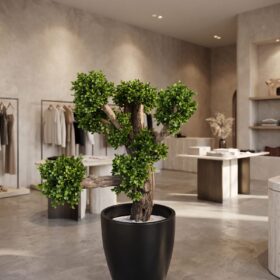
That is what a statement piece is: not a bigger version of a small plant, but a different kind of object — something a room is arranged around rather than decorated with.
Why a collection of small plants rarely adds up
Ten small plants and one large tree can hold roughly the same volume of foliage. They do not have the same effect, for three reasons.
The first is that the eye reads repetition as pattern, not as a feature. Ten similar green shapes at similar heights become background texture — pleasant, but the room looks past them. One tree at two and a half metres interrupts that scan and becomes the thing you look at.
The second is floor space. Every pot claims a footprint, a clear zone around it so nobody kicks it, and a sightline it blocks at knee height. Ten of those add up, which is why a room full of small plants often feels more cluttered than green. A large tree takes one footprint and does its work in the air above it — the part of the room nothing else is using.
The third is that small pieces need styling to look deliberate, and styling drifts. Pots get moved for cleaning, somebody adds one in a different finish, and an arrangement that looked composed starts to look accumulated. A single tree in a well-chosen planter has nothing to drift out of.
What a statement piece actually does
It fixes a focal point
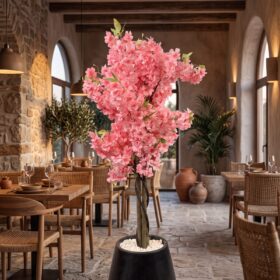
Most rooms have one spot that decides how the whole space reads — the corner you see first from the door, the turn of a staircase, the wall behind a reception desk. A statement piece claims that spot on purpose, and everything else in the room is then free to be quiet.
It works on the vertical
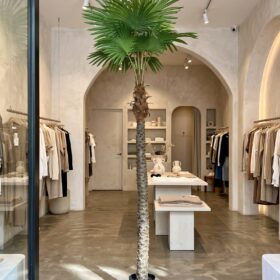
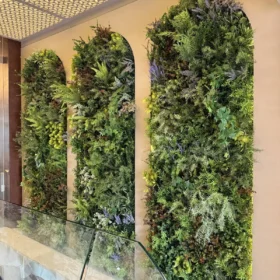
Lebanese interiors often have generous ceiling height and very little spare floor. In a double-height stairwell, a tall living room or a lobby with a mezzanine, the empty volume is above head height, and no amount of table plants reaches it. A tall ficus, a slim olive or a palm built to the room’s height fills that volume without taking another square metre of walkable floor. Where even one footprint is too much, a green wall does the same job on a surface that was doing nothing.
It carries the room’s character
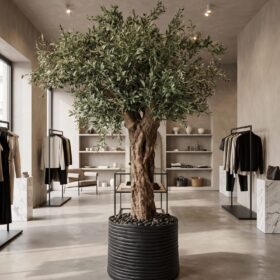
A trunk shape and a silhouette say something: an old olive with gnarled, split bark reads Mediterranean and settled; a bare sculptural piece reads modern and spare. Ten unremarkable pots say nothing in particular.
When ten small plants are the right answer
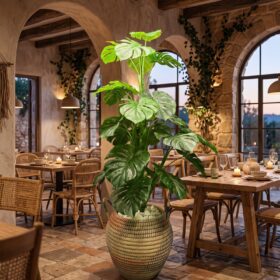
Not every room wants a single hero. Long corridors need rhythm rather than a focal point — identical planters along one side do something a tree cannot. Shelving, bar backs and window ledges want small pieces at eye level. Restaurant banquettes often need low greenery between tables, where a tall piece would block sightlines.
The useful question is not “big or small” but whether there is a spot in this room that deserves to be looked at. If there is, spend there first. If the room’s job is circulation or division, distribute instead.
Getting the scale right
The mistake we correct most often is a statement piece bought too small. A tree that clears your head by half a metre looks like furniture; one that stops a hand’s width below the ceiling looks like it belongs to the building. And canopy width matters more than height for whether a piece feels generous — it is the dimension people forget to measure.
This is the advantage of having a tree built rather than chosen off a showroom floor. We ask for the ceiling height, the available width and a photograph of the corner, then set the trunk to that height and spread the canopy to that width — with a real preserved trunk at the centre, so the piece holds up at arm’s length as well as from across the room. Custom artificial trees are made in our Jdeideh workshop to any size, and an artificial olive tree remains the piece most people arrive asking about. Outdoors, the foliage is specified anti-UV so the statement does not quietly fade into a liability.
The planter is half the statement
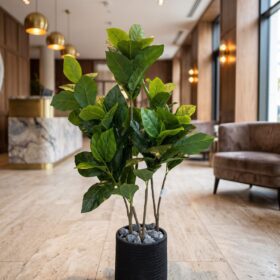
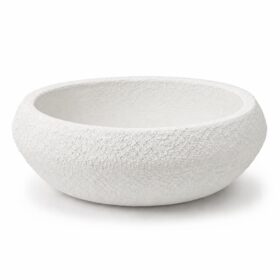
A good tree in a cheap pot is a tree with an apology underneath it. The planter sits at eye level when you stand beside the piece, so its finish and proportion get looked at closely. It is also what keeps a tall tree safe: a wide canopy needs real weight and a broad enough base, particularly outdoors or anywhere children pass. Custom planters let us size and weight the base to the tree it holds, rather than the reverse.
Frequently asked questions
How tall should a statement tree be for a normal apartment?
It depends on the ceiling, which is why we ask for the measurement rather than suggesting a standard size. The principle is to leave a modest gap at the top rather than a large one.
Can one large tree really replace several plants?
Visually, yes — in a room with a clear focal point. In corridors, on shelves and between restaurant tables, smaller distributed pieces still do a job a tree cannot.
How long does a custom piece take to make?
Custom trees generally take around 20–25 working days, since the trunk is prepared and the canopy built to your dimensions. Delivery and installation are available nationwide.
Can I see pieces before ordering?
Yes. Our showroom in Jdeideh, Metn — facing St. John Greek Orthodox church — sits with the workshop, so you can see trunks, foliage and planter finishes in person before anything is built.
Start with the corner that bothers you
If a room feels unfinished despite everything already in it, the fix is usually one considered piece rather than several more small ones. Send us a photograph, the ceiling height and the width you can give it, and we will tell you honestly whether it wants a statement tree, a green wall, or a different arrangement entirely.
Message us on WhatsApp or reach us through our contact page. We fabricate everything ourselves in Jdeideh, we deliver and install across Lebanon, and we are rated 5.0 on Google.