


Uncategorized
LED Neon vs Glass Neon: Which Sign Is Right for Your Shop?
Almost nobody who asks us for a neon sign means neon. The word now covers two quite different products that glow in a similar way: glass tubing bent over a flame and filled with gas, and LED neon, a flexible light strip in a diffusing sleeve shaped around a cut backing. In a photograph they look nearly identical. The difference matters the moment you are the one paying for the sign and living with it for years.
What each one actually is
Glass neon
A glass tube, heated and bent by hand, sealed and filled with gas. Neon gives the familiar red-orange; other colours come from argon with phosphor coatings inside the tube. It runs on high voltage through a transformer, and the light is genuinely continuous along the tube — one unbroken line, with a visible glass body even when switched off. It is also brittle: a cracked section is not repaired, it is re-bent and replaced.
LED neon
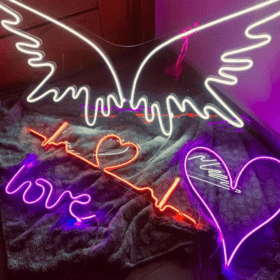
A dense row of small LEDs inside a silicone sleeve that diffuses them into a continuous-looking line. The sleeve is shaped around an acrylic sheet cut to the outline of the lettering, so the backing holds the shape rather than the light source. It runs on low-voltage DC through a driver, can be dimmed, and handles tight corners and small lettering more easily than glass.
The five questions that usually decide it
1. Where is it going?
An indoor sign behind a till and an outdoor sign on a façade are two different jobs. Outdoors you face sun, humidity, salt air near the coast and winter rain, which means a sealed sleeve and sealed connections. Glass can go outdoors, but it needs more protection and a more careful housing.
2. Can anyone reach it?
A sign at head height in a busy corridor or a gym will eventually be knocked, and glass does not forgive that; LED neon in a silicone sleeve shrugs off a shoulder or a stacked box. If it is going four metres up a stairwell nobody can reach, you want whichever option is least likely to need attention.
3. How many hours a day will it be on?
A shop sign that runs from opening to closing is on a long time. LED neon draws considerably less power than an equivalent length of glass tubing and runs cooler — which matters for the bill and for what you can safely mount it against.
4. What look are you actually after?
People skip this one, and it is the only question where glass has a clear advantage. If the point of the sign is the object — the visible tube, the hand-bent unevenness, the depth of a gas-filled glow in a dim bar — glass gives you something LED does not fully reproduce. If the point is the message, and that message is a logo or fine lettering, LED is crisper and more faithful to a brand font.
5. Who fixes it in year four?
With LED neon, a failed driver is a low-voltage component swapped out in minutes. With glass, a dead section means re-bending a tube, and the transformer costs more to replace. Lebanon’s power conditions matter here too: switching between mains and generator is gentler on a low-voltage driver than on a high-voltage neon transformer.
Where each one tends to win
- Bars and retro interiors where the fixture is part of the design and the placement is protected — glass earns its keep.
- Retail, salons, clinics, offices, gyms, cafés — LED neon, almost always, for legibility, safety and running cost.
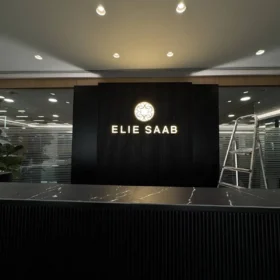
- Outdoor façades — LED neon in a sealed sleeve, or 3D letters and backlit signage if the brief wants weight rather than a glowing line.
- Small text and bilingual Arabic and Latin lettering — LED, because glass has a minimum bend radius fine detail cannot survive.
Signs that sit on greenery
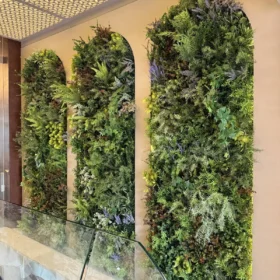
One case comes up often enough to mention: a line of glowing script across a green wall. There the decision is already made. LED neon is light enough to fix to a panel grid without a separate steel frame, runs at low voltage a few centimetres from foliage, and can follow the wall rather than standing proud of it. We build both halves in the same workshop, so the sign ends up sized to the panel joints instead of fighting them.
Getting the wording and the size right
Two decisions do more for the result than the technology itself. The first is length: measure the distance a customer first sees the sign from, and cut words until what is left reads from there. Three words lit well beat seven crammed. The second is size, which should be set by the wall and the sightline, not by a standard product width. Everything we make is built to measure in our Jdeideh workshop, so the sign is drawn to the space rather than the other way round.
The fastest way to decide is to see both lit. The showroom in Jdeideh, facing St John Greek Orthodox church, has pieces on the wall you can judge from the distance your customers will actually stand at.
FAQ
Is LED neon “real” neon?
No, and it is worth being clear about it. There is no gas and no glass in LED neon — it is an LED strip engineered to imitate a neon tube, and it does so convincingly. If authenticity of the object itself matters to you, that is an argument for glass.
Which one lasts longer?
Indoors and protected, both last a long time. In practice LED neon usually outlives glass, because what kills signs is knocks, water and electrical stress — and LED tolerates all three better.
Can a neon sign go outside in Lebanon?
Yes, with the right build: a sealed sleeve, sealed joints, a protected driver and mounting that accounts for wind. Tell us where it is going before the design is fixed, because that changes the construction, not just the finish.
Can you match my logo exactly?
Send the artwork and we will tell you honestly what survives translation into light. Fine serifs, very thin strokes and tight interior counters behave differently in a glowing line than in print.
Talk it through with us
Send a photo of the wall, the wording you have in mind and the distance it will be read from, and we will tell you which of the two suits the job. Message us on WhatsApp or use the contact page. We fabricate in-house in Jdeideh, Metn, deliver and install nationwide, and are rated 5.0 on Google.








Pingback: Making a Neon Sign From a Sketch: Bending, Mounting and Wiring - Neon Jungle Studios