

Blog
Ficus and Fiddle-Leaf: The Quiet Workhorses of Interior Greenery
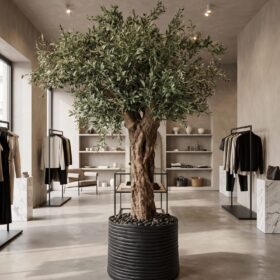
Nobody walks into a room and says “what a beautiful ficus.” That is the point of one. Where an olive tree announces itself and a cherry blossom asks to be photographed, the broad-leafed indoor trees — ficus, fiddle-leaf fig, rubber plant — make a space feel finished without becoming the subject of it. They are the greenery equivalent of good lighting: you notice the room, not the fixture.
They are also, for a lot of Lebanese interiors, the more sensible choice. Here is what they do, where they belong, and what separates a convincing one from the kind that reads as plastic from the doorway.
What makes a broad-leaf tree different to work with
An olive tree is a silhouette: its character lives in the trunk and the gaps between branches, and a good one is largely an exercise in negative space. A ficus or a fiddle-leaf is the opposite — its character is the leaf. Big, glossy, strongly veined, held on a stem that lets it tilt and catch light. That changes how the piece is built.
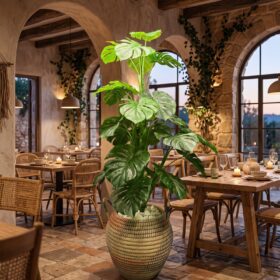
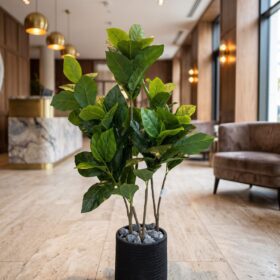
With a leaf that large, there is nowhere to hide. On a small-leaf tree the eye reads the mass; on a fiddle-leaf it reads each individual leaf, so the leaf has to survive inspection at arm’s length. We look for three things: a matte-to-satin finish rather than a hard shine, veining moulded into the leaf rather than printed onto a flat surface, and variation in tone across the canopy. Real foliage is never one colour — newer leaves at the top of a ficus are lighter and yellower, older ones lower down deeper and duller. A canopy in a single uniform green is the fastest way to lose the illusion.
The second difference is rhythm. A fiddle-leaf fig grows in a slightly awkward, reaching way — a bare stretch of stem, then a cluster of leaves, then another bare stretch. Copying that awkwardness is counter-intuitive when you assemble a tree by hand, because the instinct is to fill. Resisting it is most of the craft.
Where these trees belong
Broad-leaf trees are the best answer to the two-metre corner that is not a feature wall: beside a reception desk, the dead space between a sofa and a window, the turn of a corridor, the gap next to a staircase. Anywhere the brief is “this corner needs something” rather than “this corner needs a statement.”
They are also the right choice for low-light interiors, which in practice means most of them. A living ficus three metres from the nearest window survives for a while and then quietly thins out from the bottom; that is what happens when a plant is asked to live on reflected light. Since the real version cannot hold that spot, the comparison is not between a real tree and an artificial one — it is between an artificial tree and an empty corner.
Scale matters more than people expect. A fiddle-leaf reads correctly between roughly 1.6 and 2.4 metres: tall enough to register as a tree, not so tall that the leaf size looks wrong against the ceiling. Above that, finer foliage usually sits better in the volume. We build to whatever height a space needs, but we will say so if the proportions are fighting you.
Rooms where they earn their keep
- Offices and co-working spaces — softens hard surfaces, no watering rota, nothing to leak onto a floor
- Clinics, salons and waiting areas — calm rather than decorative, and hygienic
- Apartments with deep plan and limited light — the corner a real plant cannot hold
- Restaurants and cafés — particularly as a screen between tables, where the large leaf gives useful visual cover from a slim footprint. We cover this in more depth on our restaurant greenery page.
The planter decides half of it
A broad-leaf tree has a slim trunk and a wide canopy, which makes it top-heavy in a way an olive is not. Two consequences follow. The planter has to be properly weighted, not just heavy-looking, so a knock from a chair or a cleaner’s trolley moves nothing. And its proportions have to answer the canopy: narrow and tall reads better under a reaching fiddle-leaf than a wide, low bowl, which fights the shape.
We make planters in our own workshop alongside the trees, in fibreglass, steel or aluminium, so the finish matches a floor or joinery colour rather than being approximated from a catalogue. For semi-outdoor positions — a covered terrace, a courtyard — the foliage is specified with anti-UV treatment, which keeps a green from drifting towards grey over a few Lebanese summers.
Made to the space, not to a box size
Everything here is fabricated in our own workshop in Jdeideh, Metn. In practice that means a ficus can be built to a specific ceiling height, a canopy kept narrow on one side to clear a doorway, and the trunk set off-centre in the planter if that is what the corner wants. Finished pieces can be seen in the showroom in Jdeideh, facing St. John Greek Orthodox church. See the full range of custom artificial trees, or read about how the factory works.
Frequently asked questions
Is a fiddle-leaf fig harder to make convincing than an olive tree?
In some ways yes. The large leaf cannot hide a cheap finish, so the quality of the foliage matters more. On the other hand the structure is simpler, so there is less branch work to get wrong. The failure mode is different, not greater.
Can these trees go outdoors?
On a covered terrace or in a sheltered courtyard, yes, specified with anti-UV foliage and a weighted planter. In full exposed sun and wind, a palm or an olive is usually the better structural choice.
How long does a custom tree take?
Around 20–25 working days for a custom build, depending on size and what is in the workshop. Delivery and installation are nationwide.
Do they need any maintenance?
Dusting, and that is all. A large flat leaf collects more dust than a small one, so a wipe with a slightly damp microfibre cloth every couple of months keeps the finish reading as a real leaf rather than a matte surface.
Talk to us about your corner
If you have a space in mind, a photograph and a rough height are enough to start. Send them over on WhatsApp and we will tell you what works in that spot and what does not, or get in touch through our contact page. With these trees in particular, seeing the foliage in person is the fastest way to decide.