

Blog
The Creative Brief: How “I Want Something Green” Becomes a Design
Almost nobody arrives with a brief. What arrives is a sentence — “I want something green in the entrance,” “the wall behind the bar is dead,” “can you do a tree for the stairwell?” — and that is a perfectly good place to start. The job of the first conversation is not to make you sound like a designer. It is to find the handful of facts that decide what gets built, because once those are on the table the design mostly argues for itself.
A brief is four facts, not a mood board
People apologise for not knowing what they want. They almost always know more than they think. Here is what we actually need before we can draw anything.
Where exactly is it going?
Not the room — the spot. A tree against a blank wall, a tree in a corner between two walls, and a tree standing free in the middle of a floor are three different builds, because the canopy has to be shaped for the sightlines around it. A corner piece can be flat on two sides and nobody will ever know. A free-standing piece has to be convincing from every angle, which means more foliage, a wider spread and a heavier base.
How high is the ceiling, and what is above it?
Ceiling height sets the whole proportion of the piece. A tree that stops well short of the ceiling looks like furniture; one that brushes it looks like it grew there. But what is in the way matters just as much — a ceiling spot, a duct, a sprinkler head, a chandelier that cannot move. We would rather design the canopy around a light fitting than send an installer to discover it on the day.
What is the light doing?
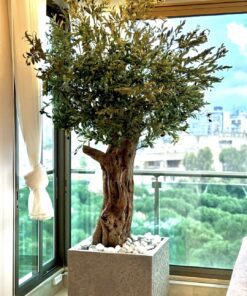
Two questions: how much daylight reaches the spot, and from which side. Daylight is the honest test of artificial foliage — colour that looks fine under warm downlights can read flat and plastic in strong sun. A piece going onto a terrace or next to a glass facade needs anti-UV outdoor foliage, not indoor leaf, and it needs a slightly more varied green than an interior piece, because sunlight flattens anything uniform.
Who has to live with it?
A restaurant manager, a homeowner and a facilities team want different things from the same object. In a restaurant, we ask where the service path runs and whether staff will brush past the piece twenty times a service. In a home, we ask about children and a vacuum cleaner. These answers change the base, the planter and how firmly the lower branches are fixed — not the look.
From answers to a specification
Those four facts turn into a short written spec: species, overall height, canopy spread, trunk character, foliage mix, planter type and finish, and how the piece is anchored. That is the document we build from, and it is the document you approve before anything is cut.
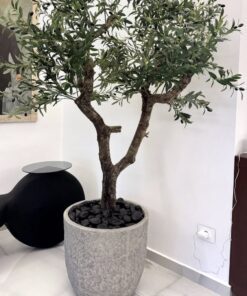
Species is usually the easiest decision and the one people agonise over most. Olive suits almost every Lebanese interior because the eye already accepts it — the silver underside of the leaf does something flattering to stone and plaster. Ficus and fiddle-leaf fill volume faster for the same height. Blossom brings colour but reads as a seasonal statement, so it works better where it is the point of the room than where it is background. If you cannot choose, describe the feeling you want the room to have and let us put two options in front of you.
Scale is where we push back most often. The instinct is to order small, because a large tree sounds like a commitment. In a double-height stairwell or a hotel entrance, small is the expensive mistake — the piece reads as an accessory and the volume stays empty. One properly scaled tree almost always beats three cautious ones.
When the wall is the answer instead
Not every brief that begins with “a tree” ends with one. If the floor space is genuinely needed, or the spot is a corridor, a green wall does the same work in a few centimetres of depth, and it can be built to any outline — around a doorway, behind a bar, up a stairwell, or in a band at eye level. We will say so if that is the better answer, even when it is the smaller job. Sometimes the right outcome is a wall plus a neon piece across it, because what the client actually wanted was for people to photograph the corner.
Things that are genuinely useful to send
A photograph taken from where people enter the room, and a second from where they sit. One rough measurement — ceiling height, or the width of the wall. A note of anything that cannot move. If you have a drawing from an architect or interior designer, send that instead; we quote from drawings regularly and it removes most of the guesswork.
What is not useful is apology. An olive tree we built for Elie Saab’s apartment started from the same kind of short message as everything else. The brief gets written in the conversation, not before it.
What comes back to you
A proposal with the specification, a visual reference of the intended piece, and a price. Custom trees are made in our Jdeideh workshop and typically take around 20–25 working days from approval, with delivery and installation anywhere in Lebanon. If you would rather see the material before committing, the showroom in Jdeideh — facing St. John Greek Orthodox church — has pieces standing, and ten minutes with a trunk in your hands settles more questions than any photograph.
FAQ
Do I need to know the size I want before contacting you?
No. A photo of the space and the ceiling height are enough. Sizing the piece correctly to the room is part of what we do, and we build to any size.
Can you work from an architect’s drawing?
Yes. Plans and elevations are the easiest thing to quote from, and we work directly with architects and interior designers on commercial projects.
What if I don’t like the design you propose?
Then we revise it. Nothing is cut until you have approved the specification, which is exactly why the spec exists.
Can you match a tree to something I have seen?
Usually. Send the reference image. Because we fabricate in-house rather than order from a catalogue, trunk character, height and canopy shape are all variables we control.
Start the conversation
One sentence and a photo is a complete enquiry. Send it on WhatsApp or through the contact page, and we will come back with the questions above — and then with a design.