


Blog
Artificial vs Real Olive Tree for a Lebanese Home: The Honest Comparison
A real olive tree can outlive everyone who plants it — if it is planted in the right place. Put the same tree in a living room, a lobby or a shaded corner of a restaurant and it starts a slow decline that no amount of care fully reverses. That, more than price or taste, is what the choice between a real and an artificial olive tree comes down to: where the tree is going to stand.
We make artificial olive trees for a living, so read this with that in mind. But there are places where a real olive is the better choice, and we would rather say so than sell someone the wrong tree.
What a real olive tree actually needs
The olive is a Mediterranean tree built for exactly the conditions Lebanon’s terraces give it: strong direct sun, dry air, free-draining soil, wind, and a cool winter that helps it set fruit. Take those away and it struggles.
- Light. Olives want full sun for most of the day. Behind glass, even beside a large window, they get a fraction of that. Growth thins, and the tree begins to shed leaves.
- Water. Indoors, the most common way to lose an olive is overwatering. Soil in a pot without sun stays wet, roots rot, and by the time the canopy shows it the damage is done.
- Air and pests. Still indoor air suits scale insects and similar pests that an outdoor tree shrugs off.
- Weight. A mature olive in soil is extremely heavy. For an apartment, a terrace slab or an upper-floor restaurant, that is a structural question before it is a design one.
None of this makes a real olive a bad tree. It makes it an outdoor tree.
Where a real olive tree is the right answer
If you have a garden, a courtyard with open sky, or a villa entrance with deep soil, plant a real one. It grows, it changes with the seasons, it may give fruit, and it gains character every year you have it. Nothing we build does that, and we would not pretend otherwise.
A real olive is also the honest choice if part of what you want is the tending itself — the pruning, the watching, the living thing.
Where an artificial olive tree wins
Everywhere the conditions above cannot be met, an artificial tree is not a compromise; it is the only version that will still look right next year.
Interiors without full sun
Lobbies, offices, living rooms, stairwells, restaurant dining rooms, clinics. An artificial olive does not care whether the nearest window faces north or whether the lights go off at night.
Spaces nobody will look after
A real tree in a commercial space needs someone responsible for it every week, including holidays and closures. An artificial tree asks for occasional dusting.
Exact size, from day one
A real olive arrives at whatever size the nursery has. Ours are made to any size in our Jdeideh workshop, so the tree fits the ceiling height and canopy spread you actually have — including awkward spaces like a double-height void or the turn of a staircase. See our custom artificial trees for how that works.
Exposed terraces and rooftops
A potted real olive on a windy upper-floor terrace faces heat, wind and a limited root run. An artificial one built for outdoors uses anti-UV foliage so the sun does not bleach it, and a weighted base suited to the position.
How close does artificial get to real?
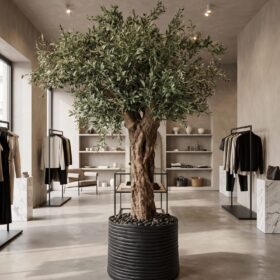
This depends almost entirely on the trunk. Our olive trees are built on preserved natural trunks, so the bark, the twists and the hollows are genuinely those of an old tree. What is artificial is the foliage, and a careful look at arm’s length will tell you so. At the distance a tree is normally seen from — across a room, from a doorway, from a table — a well-made one reads as an olive tree, not as an object.
Two things give cheap artificial trees away: a moulded trunk with repeating texture, and a canopy clipped into a perfect, dense dome. When comparing, look at those first.
A quick way to decide
- In the ground, open sky, someone to care for it: choose a real olive.
- Indoors, or in a pot on a slab: choose artificial.
- Commercial space with no one assigned to plants: choose artificial.
- Need a specific height or shape: choose artificial, made to measure.
Plenty of properties end up with both — real trees in the garden, artificial ones inside where the garden cannot follow. The planter matters either way; we make custom planters sized to the tree they hold.
Frequently asked questions
Can a real olive tree survive indoors in Lebanon?
For a while, beside a very bright window and with careful watering. Long term, most indoor olives thin out and decline because they do not get the direct sun they need.
Does an artificial olive tree need any maintenance?
No water, light or pruning. Dust the foliage occasionally and it stays as it was installed.
Can an artificial olive tree go outdoors?
Yes, if it is built for it: anti-UV foliage and a base weighted for the wind at that spot. Tell us how exposed the position is when you order.
How long does a custom olive tree take?
Roughly 20–25 working days to make, then we deliver and install anywhere in Lebanon.
See one before you decide
The easiest way to settle the question is to stand next to one. Our showroom in Jdeideh, facing St John Greek Orthodox church, has artificial olive trees you can walk around and touch, and the workshop where they are made is ours — more on that on our artificial tree factory page.
Or send a photo of the space and its ceiling height on WhatsApp, and we will tell you honestly whether it wants a real tree or one of ours. You can also reach us through the contact page.