

Blog
Design Decisions That Separate a Good Install From a Forgettable One
Most people cannot say why the greenery in one room stays with them and the greenery in another disappears. Both rooms might hold a two-metre tree in a decent planter. Both trees might be well made. One reads as part of the architecture; the other reads as something that was delivered on a Tuesday and put down.
The difference is almost never the quality of the piece. It is a short list of decisions, and most of them are taken in the room with a tape measure rather than in a catalogue. Here is what we actually argue about before a single branch is wired.
What the piece is for, before what it is
The first question is not which tree. It is what the greenery is being asked to do in that space. Three jobs come up again and again, and they pull in different directions:
- Filling volume. A double-height stairwell or an atrium has empty air above eye level that the furniture cannot reach. The piece needs height and an open canopy that reads from below.
- Softening hard surfaces. A room of glass, stone and steel needs irregular edges. Here density and leaf movement matter more than sheer size.
- Directing attention. An entrance, a reception desk, a wall behind a bar. The greenery is a frame for something else, and must not compete with it.
A piece designed for the wrong job is the single most common reason an install feels flat. A beautifully dense ficus solving a volume problem it cannot reach will always look slightly lost.
Height is a relationship, not a number
Clients usually arrive with a height in mind, and it is usually a round number. The useful measurement is the gap left above the canopy. A tree that stops a hand’s width below a ceiling looks squeezed; one that leaves a clear, deliberate band of wall above it looks placed.
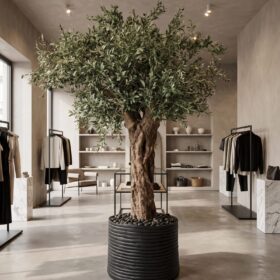
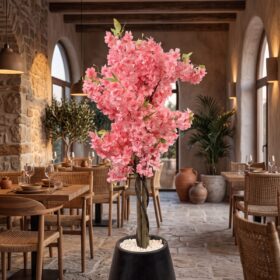
Where the piece sits also changes what the number means. A tree beside a sofa is read against the back of that sofa. A tree in a corridor is read against the door frames. Because we build custom artificial trees to any size in the Jdeideh workshop, the height can be set from the room rather than from a product list — which is the whole point of making rather than importing.
The planter is half the piece
This is the decision most often rushed, and it is the one visitors see first. A planter sits at knee and hip height, which is exactly where the eye lands when someone walks past. Four things get decided here:
Diameter against canopy width
A wide canopy over a narrow planter looks unstable even when it is perfectly weighted. The planter has to look like it could hold the tree.
Height against the furniture line
A tall planter raises the canopy without adding trunk — useful when a tree sits behind seating and the lower branches would otherwise be buried.
Finish against the room
Matte and textured finishes disappear into stone and plaster interiors. Gloss draws light and announces itself. Neither is wrong; choosing by accident is.
Weight and base, for anywhere exposed
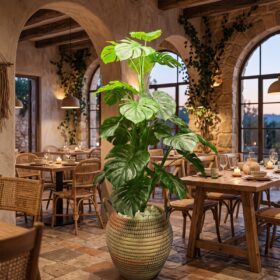
Outdoors or in a doorway with a draught, the base carries the design. Our custom planters are built for the position they will stand in, which for a Lebanese terrace means weighting for wind and a finish that will take summer sun.
Light is decided too late, almost always
Greenery absorbs light rather than returning it. A tree lit only by a flat ceiling panel loses all its depth — the canopy becomes one dark mass instead of layers. A single warm downlight slightly off-centre, or a small uplight at the base, restores the shadow between branches that makes a tree read as a tree.
If the lighting is already installed and cannot move, that becomes a design input: the canopy gets shaped for the light that exists, with the fuller side turned towards the brightest approach. It is far easier to decide this before the piece is built than to fix it afterwards.
Edges, seams and the back of things
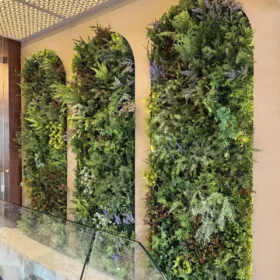
Forgettable installs are usually fine in the middle and wrong at the edges. On a green wall, the panel joins and the perimeter are where the eye checks whether the surface is real; a finished edge and a broken, irregular outline do more for realism than the foliage mix in the centre. On a tree, it is the point where trunk meets soil, and the branch pointing straight at the wall that should have been turned.
None of this is expensive. It is attention, and it is the reason we prefer to install our own work rather than drop it at a loading bay.
Fewer pieces, better placed
The last decision is usually subtraction. Three medium trees spread evenly along a wall read as decoration. One large tree at the point where people turn, with the wall left bare, reads as a design. In commercial installations this also protects the budget: the money goes into the piece people will stand next to, not into filler nobody looks at twice.
Questions we get asked
Can you tell what will work from photos?
Usually yes, if we get three or four: the empty space, the view from the main entrance, and something that shows the ceiling and the nearest furniture. A rough width and ceiling height with them makes the first proposal much closer.
Do I need to decide the planter at the same time as the tree?
It is better to. The planter changes the canopy height, the proportions and the budget, so deciding it late usually means revisiting the tree.
How long does a custom piece take?
Custom trees are generally around 20 to 25 working days from approval, which includes building, finishing and scheduling the installation. Pieces already in the Jdeideh showroom are available straight away.
Can you work from an architect’s drawing instead?
Yes — plans, elevations and renders are all usable, and often faster than photographs because the dimensions are already there.
Come and see the decisions in person
All of this is easier to judge standing next to a finished piece than reading about it. The showroom in Jdeideh, facing St. John Greek Orthodox church, sits next to the workshop where the trees are made, so you can see both the result and how it was built. We deliver and install nationwide, and we are rated 5.0 on Google.
Send a photo of the space and a rough ceiling height on WhatsApp, or use the contact page, and we will come back with a size, a planter and a position worth arguing about.