


Blog
Retail and Mall Greenery: Drawing the Eye Without Blocking the Product
Greenery in a shop has one job and one rule. The job is to pull a passing eye in from the walkway. The rule is that it must never stand between that eye and the product. Nearly every retail greenery mistake we are asked to fix comes from getting those two the wrong way round — a handsome planter installed exactly where a customer could once see the whole wall of stock.
Start by mapping the sightlines, not the empty floor
The instinct in a shop is to find gaps in the floor plan and fill them. That is how a 1.2 m planter ends up in the middle of a 2 m aisle. Better to stand at the three or four points customers actually look from — the walkway outside, the threshold, the till, the far end of the main run — and photograph each one. The greenery goes where it reads in those frames without covering stock, signage or a cashier’s line of sight.
In practice that pushes almost everything into one of three zones: above head height, against vertical surfaces, or into the corners that stock never wanted anyway.
Above the sightline
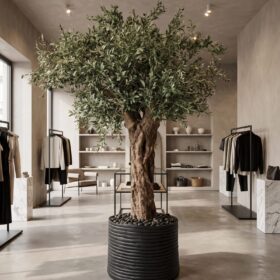
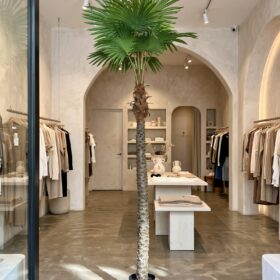
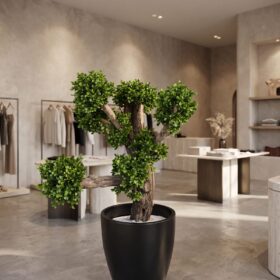
Most shelving tops out between 1.8 m and 2.2 m, and above that sits a metre or two of nothing. A tree with a high, open canopy — clear trunk to roughly 1.8 m, foliage spreading above it — fills that void and still lets a shopper see straight through at eye level. Trailing foliage along the top of a gondola run or a bulkhead works the same way: visible from the walkway, invisible as an obstruction.
Vertical surfaces: columns, back walls, cash desks
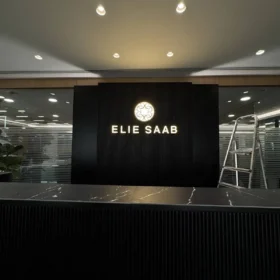
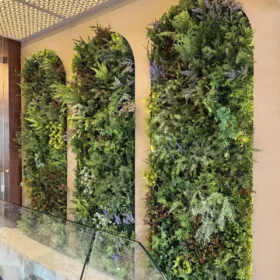
Columns are the most underused surface in retail: structural, immovable, and nothing sells off them. Wrapping one in foliage or cladding it in panels costs no floor space at all. The same goes for the wall behind a cash desk, which every customer stares at while paying — a modest run of artificial green wall there does more brand work than a far larger piece mid-shop.
The corners stock does not want
Every shop has them: the dog-leg beside the fitting rooms, the metre behind the door swing, the triangle where two runs of shelving meet. Dead for merchandising, perfect for a single floor piece. Fill one well and the room stops feeling like a warehouse.
Mall common areas play by different rules
A unit inside a mall has two separate problems. Inside your lease line, the constraint is selling space. Outside it — the walkway, the atrium, a seasonal activation — the constraint is mall management: approved footprints, clearances for circulation and fire routes, and whether a piece can be installed and struck without a forklift.
So a piece built for a mall activation needs to be movable by two people, stable without being bolted down, and sized to pass a service corridor and a goods lift. We build for that explicitly: lighter internal frames, weighted bases rather than fixings, and planters that split from the tree for transport. It is a different brief from a permanent install in a villa entrance, and worth saying so when you ask for a quote.
Why shops end up with artificial rather than real
Retail lighting is the quiet killer. Shops are lit for product — bright, directional, often warm spots on a grid, with almost no daylight reaching the back half of a unit. The real plants that survive that are mostly short, dull and not what anybody had in mind. Add a watering schedule nobody on a sales floor has time for, soil near stock, and a dying plant in the window reading as neglect, and the choice usually makes itself.
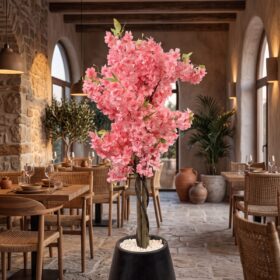
Quality then matters more than usual, because retail greenery is inspected at close range by bored shoppers in a queue. Preserved natural trunks, foliage layered at the inner branches rather than only the tips, and a planter finish that matches the shopfitting are what keep a piece from looking like a prop. For an open frontage or a terrace, anti-UV foliage is not optional — a west-facing shopfront here takes more direct afternoon sun than most balconies.
Specify these four things before you order
- Footprint and height, measured in place. Not the planter diameter alone — the canopy spread at its widest, which is what people walk into.
- Base type. Weighted for free-standing pieces in a high-traffic aisle; slimmer where it sits against a wall or inside a custom planter built into the shopfitting.
- Cleaning access. Anything above a display must be reachable with a duster from a two-step ladder, or it will grey over.
- Whether it moves. Seasonal resets are a fact of retail life. Say upfront if a piece will be repositioned four times a year and it gets built for that.
All of it is made in our own workshop in Jdeideh, Metn, which is why a retail piece can be sized to an awkward column or a given bulkhead height rather than to whatever a catalogue offers. Custom trees run roughly 20–25 working days; showroom pieces are available sooner, and for an opening with a fixed date that distinction matters.
FAQ
How much floor space does retail greenery actually need?
Less than most plans allow, placed well. A single tall piece in a dead corner and a green wall on a column can change a unit while taking under a square metre of sellable floor between them.
Will a tree block a security camera or sprinkler?
It can, which is why canopy spread and ceiling clearance are measured on site before anything is built. Mall units usually have a required clearance below sprinkler heads, and the canopy is shaped around it.
Can greenery be matched to our brand colours or signage?
Planter finishes can be matched to shopfitting and foliage mixes adjusted lighter or darker. Where a brand wants its name glowing against the foliage, a custom neon or LED sign is made in the same workshop, so the two are built to fit each other.
Do you install in malls outside Beirut?
Yes — we deliver and install nationwide, and handle commercial installations outside trading hours where mall management requires it.
Talk through your unit
Send a photo from the walkway and one from the threshold, with your ceiling height and main aisle width, and we can say quickly what will read well and what will be in the way. Message us on WhatsApp or through the contact page, or see the pieces in person at the showroom in Jdeideh, facing St. John Greek Orthodox church.