

Blog
Ready-Made Artificial Tree or Made to Measure? How to Decide
There are two ways to end up with a large olive tree standing in the corner of your living room. You can choose one that already exists, see it, pay for it and have it delivered. Or you can describe the corner, and have a tree built to fit it. Both are legitimate routes, and the right one depends far less on budget than most people assume — it depends on how fixed the space is, and how closely anyone will look at the finished piece.
Here is how to tell which route is yours.
What “ready-made” actually means
A ready-made tree is a finished piece: a set height, a set canopy width, a trunk that is what it is, and a base already fitted. Its great advantage is that there is nothing to imagine. You walk into the showroom in Jdeideh, you stand next to it, you see how the light falls through the foliage and how the trunk reads from two metres away. No rendering, no sample, no leap of faith.
The limitation is equally plain: the tree does not move to meet your room. If your ceiling is 2.70 m and the tree wants 3.20 m, the tree wins that argument. If your alcove is 90 cm deep and the canopy spreads 140 cm, you will be brushing past leaves every time you cross the room.
What changes when a tree is made to measure
Custom work is not simply “bigger” or “more expensive”. It changes three specific things, and it is worth knowing which of them you actually care about.
Height, and the gap above the canopy
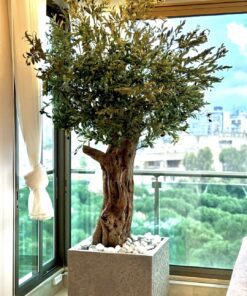
The single most common mistake we see is a tree that technically fits and still looks wrong, because there is no breathing room between the top of the canopy and the ceiling. A made-to-measure tree is built to a stated ceiling height, which means the canopy can be stopped deliberately — full where the eye lands, tapering before it reaches the slab. In a stairwell or a double-height entrance, where the whole point is to fill vertical volume, this is not a refinement. It is the entire job.
Trunk character
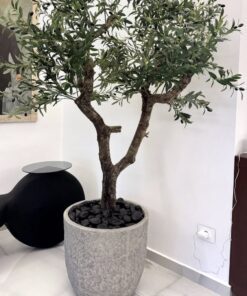
We build with preserved natural trunks, which means each one carries real bark, real splits and real growth history. That is also why no two are identical. With a ready-made piece you take the character of the trunk in front of you. With a tree made to measure, the trunk can be chosen for the room — a leaning, gnarled olive for a restaurant corner where people sit close to it, something straighter and more upright where it has to read cleanly against a wall.
The base and the planter
A ready-made tree comes with a base that works. A custom piece lets the base become part of the design instead of something to hide: sized to a built-in bench, weighted for an exposed terrace, or dropped into a planter made in the same workshop so the proportions actually agree with each other.
When ready-made is the right answer
Choose ready-made when the space is forgiving and the timing is not. Specifically:
- You have a reasonably standard ceiling and an open corner, not a tight recess.
- You want to see the exact piece before committing — which is a completely reasonable way to buy.
- You need it soon. A custom tree is a fabrication job, and the established lead time for custom work is roughly 20–25 working days.
- You are filling several spots at once and want a consistent, repeatable look across them.
- It is a rented flat or a short-term fit-out, and the tree may well move to a different room in two years.
When made to measure is the only honest option
There are situations where a ready-made piece will never quite land, and it is better to say so early:
- Awkward architecture. Low soffits, deep alcoves, a sloping ceiling, a tree that has to clear a doorway swing.
- Height beyond the usual. Anything that has to hold a stairwell, an atrium or a tall lobby.
- Outdoors. Terraces and entrances need anti-UV foliage and weighting judged for that specific exposure — wind matters as much as sun.
- A named look. If someone has shown you a reference image and expects that species, that silhouette and that density, matching it means building it.
- Commercial spaces where the greenery is part of the brand. We have made an olive tree for Elie Saab’s apartment and signage for his headquarters; in work of that kind, “close enough” is not a finish.
A quick way to decide
Measure three numbers before you do anything else: ceiling height, the width available at the widest point of the canopy, and the depth from the wall. Then photograph the corner from the doorway. If a ready-made piece in the showroom sits comfortably inside those three numbers, buy it and enjoy it. If any one of them is tight, custom will cost you a few weeks and save you years of looking at something that nearly fits.
FAQ
Is a made-to-measure tree always more expensive?
Not automatically. Size, trunk and foliage volume drive the figure far more than whether the piece is custom. A modest custom tree can sit below a very large ready-made one. The reliable way to know is to send the dimensions and get a quote for both.
How long does a custom tree take?
Around 20–25 working days for custom trees, since the trunk is prepared, the frame built and the foliage applied in our own workshop in Jdeideh. Ready-made pieces are available immediately.
Can a ready-made tree be modified afterwards?
Often, yes — because we fabricate in-house rather than import finished stock, canopies can be thinned, reshaped or moved into a different planter. It is worth asking before you assume a piece is a fixed object.
Do I need to visit the showroom to order custom work?
No. Photographs and measurements are enough to start, and we deliver and install nationwide. But seeing foliage and trunks in person does make the choices easier, so visit if you can.
Tell us about the corner
Send a photo and three measurements and we will tell you honestly which route makes sense — including when the ready-made piece is the better buy. Message us on WhatsApp, or use the contact page. The showroom is in Jdeideh, Metn, facing St. John Greek Orthodox church, and we deliver and install anywhere in Lebanon.