


Blog
Artificial Jacaranda Tree: Sizes, Planters and Prices in Lebanon
Oct
For three or four weeks in late spring, the jacarandas along the coast turn blue-violet and everyone photographs them. For the other eleven months they are a feathery green tree, and in a cold winter a bare one. An artificial jacaranda keeps the flowering weeks all year, indoors, without petals on the floor. This guide covers what the tree is, the two sizes we stock in Lebanon, where the colour works, which planter to put it in, and what it costs delivered.
What a jacaranda is
Jacaranda mimosifolia is a tree from South America, planted in Beirut gardens and along streets across the Mediterranean because it takes heat and gives the one colour almost no other tree gives: a soft blue-violet, somewhere between lilac and lavender. The foliage is as distinctive as the flower: finely divided, fern-like leaves that make a light, open canopy you can see through. A jacaranda never looks heavy, even at full size.
The artificial version keeps those two traits. The leaves are moulded in small, doubly divided fronds on wired stems, so the canopy stays airy and can be shaped. The flowers are fabric clusters, in either a deep blue-violet or a paler lilac, fixed among the foliage rather than on bare branches. Nothing drops, nothing needs water, and the colour does not depend on the season.
The sizes we sell
We stock two jacarandas in Jdeideh, both 200 cm tall, both $130, both sold without a pot so you can choose the planter.
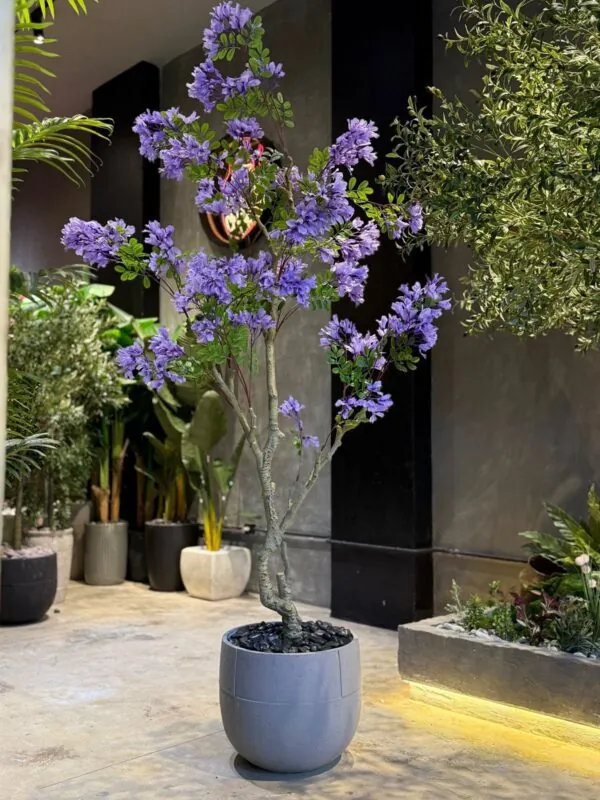
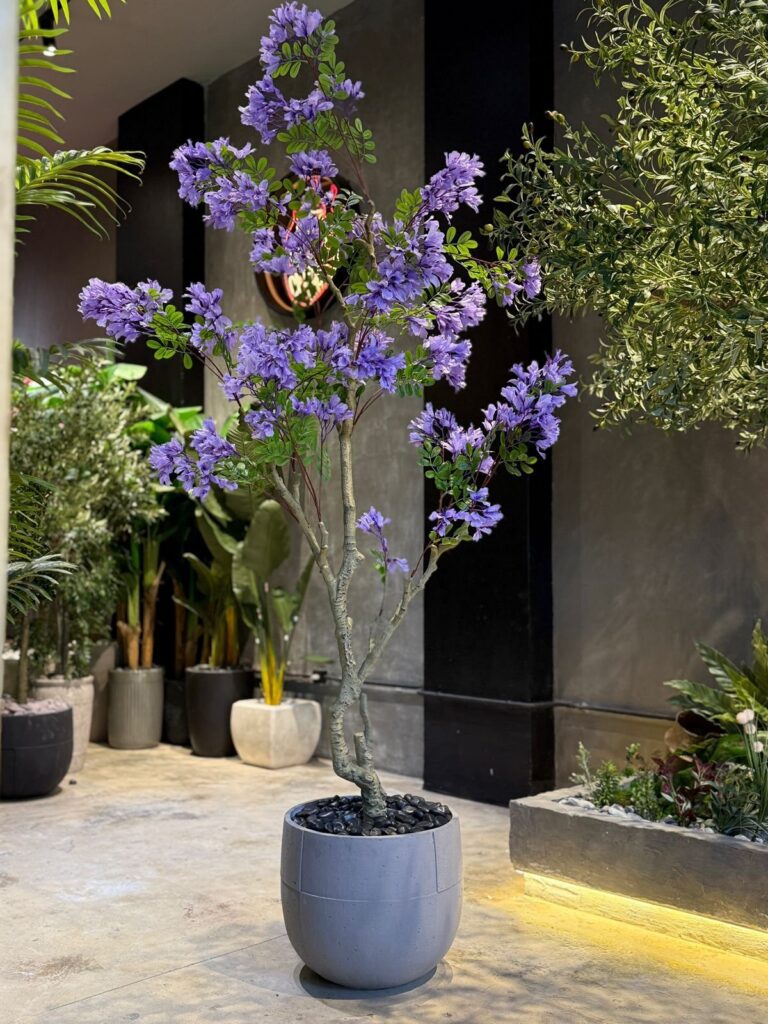
- Jacaranda Tree 200 cm: green feathery foliage with blue-violet flower clusters through the canopy. The leaf carries the tree; the flowers are the accent. This is the one for rooms that are already warm in colour, or where you want a tree that reads as green from a distance and reveals the colour up close.
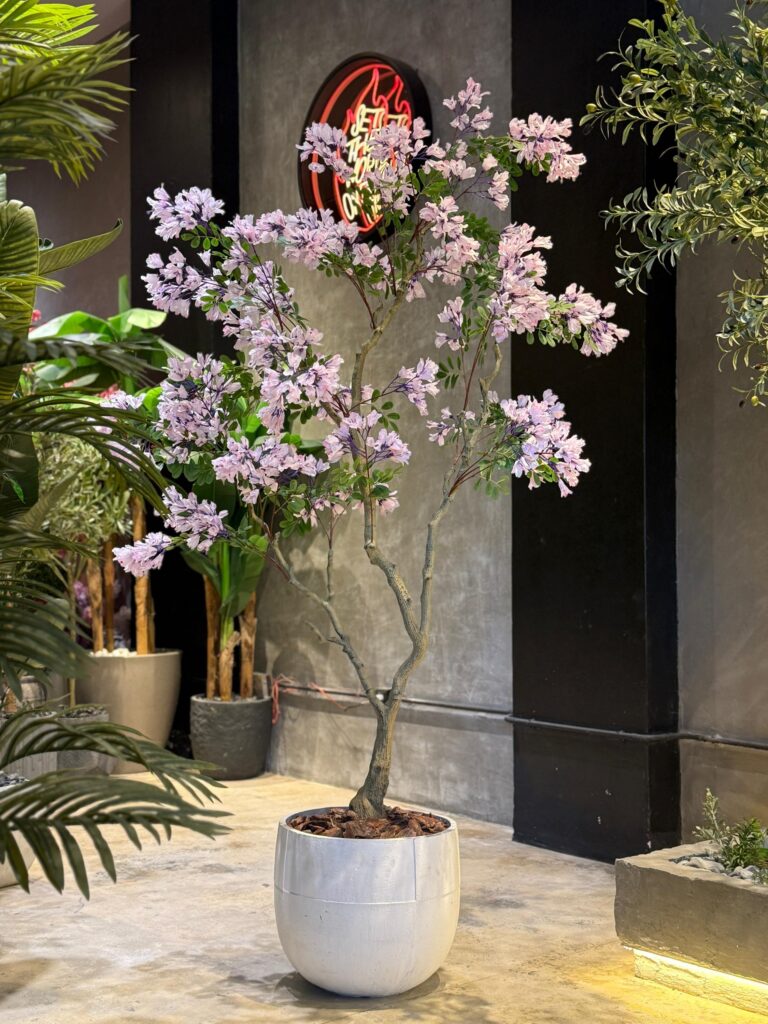
- Jacaranda Tree 200 cm lilac: a softer lilac canopy with more flower than leaf, the look of the tree in full bloom. It reads as a coloured tree from across the room. Pale walls show it best.
Both ship in a box of about 205 × 25 × 25 cm and weigh about 8 kg packed, so they pass through any door and go up a lift standing on end. The canopy arrives folded and is opened and shaped on arrival, which is also where you decide how dense or how open you want it.
A jacaranda of another height, or one with a thicker trunk for a lobby, is built as a custom piece on a preserved natural trunk, in the same way as our blossom trees. That route starts on the custom artificial trees page.
Where it looks right
The jacaranda’s colour is its reason to exist, so put it where that colour has something to work against.
- Against a pale wall. Off-white, bone, light grey, pale wood. The fine foliage reads as a drawing against a plain background and disappears against a busy one.
- In a room that is all green. A lobby or restaurant full of olives, palms and ficus gets one piece of colour, and the jacaranda does it without the sweetness of a pink cherry blossom.
- Beside a window or a mirror, where the open canopy lets light through instead of blocking it. A dense ficus in the same spot darkens the corner; a jacaranda does not.
- Bedrooms, bathrooms and spas. The lilac version suits soft, quiet rooms where a strong green tree would be too much.
Where it does not belong: a sunny terrace. Lilac and blue-violet are the first colours to soften in direct sun, and these two pieces have indoor foliage. Keep the jacaranda inside and give the terrace an olive or a palm.
Pairing it with a planter
A 200 cm tree with an open canopy needs a planter that gives it weight at the bottom: about 40–50 cm wide and 35–45 cm tall. Narrower than that and the tree looks like it is standing on tiptoe; wider and the planter becomes the piece. The nursery pot the tree comes in sits inside the planter, packed with pebbles or dressed with moss.
- Matte black or dark ceramic, such as the New Ceramic Moon Black (from $35): the strongest contrast for the lilac, and the choice for a modern interior.
- Pale fibre or stone, such as the Round Fiber Greige 52 cm ($85) or the Fiber Mosaic Pot (from $55): quieter, and better in a room with wood floors and linen.
- Avoid coloured planters. Terracotta, blue or green glazes fight the flower. White works, but shows dust at floor level in a restaurant.
When you add a jacaranda to the cart, the product page suggests three planters in the right size for it, and a planter chosen from those suggestions is 5% off in the cart. More sizes are in pots and planters, and planters made to a given size are on the custom planters page.

Price and delivery in Lebanon
Both jacarandas are $130, in stock, and leave the workshop within 3 business days. Delivery by our own team is calculated at checkout by area: a single tree to Beirut, Metn or Baabda starts at $8.80, with higher rates by distance for the rest of the country, and a planter counts as an extra piece. Cash on delivery is available in Lebanon. Installation, which for this tree means setting it in its planter, dressing the top and shaping the canopy, is available on request.
Outside Lebanon the product page shows a live DHL Express rate for your country, and a slower economy option can be quoted within 24–48 hours for larger orders. Prices are in US dollars.
Caring for it
The feathery foliage holds dust, so clean it with moving air rather than a cloth: a hairdryer on cool or a small blower, top down, every three to four weeks. Do not wipe the fabric flowers with water, and keep the tree away from windows with afternoon sun. The full method is in how to clean a dusty artificial tree.
Frequently asked questions
How tall is the artificial jacaranda tree?
Both pieces we stock are 200 cm tall, measured from the base of the nursery pot to the top of the canopy. The canopy arrives folded and opens out once shaped. Other heights are built as custom pieces.
What is the difference between the two jacarandas?
The Jacaranda Tree 200 cm is mostly green foliage with blue-violet flower clusters. The lilac version is mostly flower, in a paler lilac, and reads as a coloured tree from a distance. Both are $130.
Does the artificial jacaranda come with a pot?
No. It arrives in a plastic nursery pot that sits inside the planter you choose. The product page suggests planters in the right size, and a planter chosen from those suggestions is 5% off in the cart.
Can I put it on my balcony?
Not these two: their foliage is for indoors, and lilac is the first colour to fade in direct sun. For a balcony we would build a custom piece with anti-UV foliage, or suggest an olive or a palm.
How much is delivery in Lebanon?
From $8.80 for one tree in Beirut, Metn and Baabda, more by distance elsewhere, calculated at checkout. Stock pieces leave within 3 business days.
To see both jacarandas side by side, visit the showroom in Jdeideh, facing St John Greek Orthodox church, or ask on WhatsApp with a photo of the corner and we will tell you which one suits the wall.