

Blog
How to Clean Artificial Plants and Trees Properly
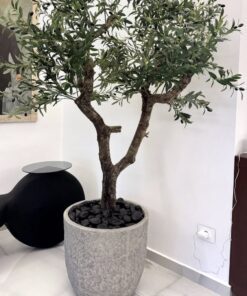
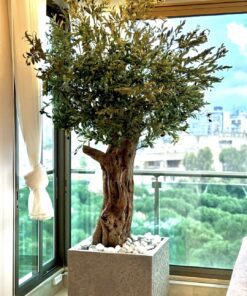
Nobody buys an artificial olive tree because they want a cleaning job. That is half the point of it: no watering, no light, no leaves on the floor every autumn. But there is one thing an artificial tree or green wall does ask for, and it is the thing most owners get wrong — dust. Done properly it takes minutes. Done badly, with the wrong cloth or the wrong spray, you take the finish off foliage that would otherwise have outlasted the sofa beside it.
Why dust is the only real enemy
Dust does not damage foliage. It flattens the light. A convincing leaf works because it has a slight sheen in places and a matte finish in others, and because the colour is not uniform across the surface. A grey film evens all of that out, and the tree stops reading as a plant and starts reading as an object. Because it happens gradually, people rarely notice — until the day after it is cleaned, when the green comes back.
In Lebanon it happens faster than people expect: construction dust, road dust through open windows, and the fine layer that settles through the dry months. A piece near a balcony door needs attention more often than one in the middle of a room. Here is how we tell clients to handle it, based on how the pieces are actually built in our Jdeideh workshop.
The method: dry first, damp second, never wet
1. Dust dry, from the top down
Take a soft feather duster or a clean, dry microfibre cloth and work from the highest branches downward, so what you loosen falls onto foliage you have not cleaned yet. Cup each cluster of leaves lightly in the cloth and pull outward along the leaf rather than scrubbing across it. Leaves are printed and coated, and that coating gives them their colour depth; hard rubbing wears it thin.
For dense canopies, a hairdryer on its cool setting or a can of compressed air reaches the interior where a cloth cannot. Keep it at a distance and keep it moving — on a large tree it is the fastest way to do the inner branches.
2. Damp-wipe only what needs it
If the foliage has gone past dust into a slight film — kitchens, cafes and anywhere near a road are the usual culprits — follow the dry pass with a lightly damp cloth. Lightly is the operative word: wrung out until it is barely cool to the touch, water only or with the smallest amount of mild dish soap. Wipe, then dry the leaf with a second cloth. Never spray into the canopy, and never let moisture sit where branches meet the trunk.
3. The trunk is the part people forget
On our trees the trunk is a real preserved trunk, so the bark behaves like wood, not plastic. Use a dry brush — a soft paintbrush lifts dust out of the splits and hollows that make the bark look its age — and leave it dry. Never oil or polish it, and never use anything meant to “feed” wood: the surface is finished already, and a product sitting on it attracts more dust than it removes.
What not to use, ever
- Leaf shine sprays and furniture polish. They leave a tacky surface that grabs dust within days, and an unnatural gloss.
- Bleach or solvent-based cleaners. These lift colour from printed foliage, and that damage is not reversible.
- Pressure washers or a shower head indoors. Driven water reaches the internal structure and the base.
- Vacuum nozzles held against foliage — individual leaves pull free. Use a brush attachment on the lowest setting, held just off the surface.
Green walls and dense panels
A green wall is not cleaned the way a tree is. There are no branches to hold and the foliage is deliberately packed, so the answer is air rather than cloth: a cool hairdryer, compressed air, or a soft brush worked downward across the panel face. A custom artificial green wall mostly needs this along its top edge and wherever it meets a light fitting — that is where dust lands and where heat draws it.
Outdoor pieces are a different job
Outdoor foliage on our pieces is anti-UV treated, which protects the colour against Lebanese sun, and rain does much of the cleaning for you. Near the coast, rinse off salt with a gentle hose rather than a jet and let the piece dry in open air. While you are handling it, check the anchoring and the weight in the planter — that is when you will notice whether a windy position has worked something loose.
How often is enough
No schedule fits every space. A quiet office corner can go months and look untouched; a restaurant on a busy street wants a light dusting every few weeks. The honest test: from two metres away in daylight, wipe one leaf with a cloth, then look again. If that leaf is now a different colour, the whole piece is due.
FAQ
Can I wash artificial leaves in water?
A damp cloth, yes. Submerging or hosing an indoor piece, no — water reaches the internal structure and the base, and it does not dry out quickly there. Outdoor pieces can take a gentle rinse.
Will cleaning make the colour fade?
Correct cleaning will not. Fading comes from hard scrubbing and from chemical cleaners stripping the coating on the leaf. Dry dusting with an occasional light damp wipe is safe indefinitely.
My tree looks dull even after dusting. What now?
Usually a film rather than dust, or foliage that has reached the end of its life after long exposure. Both are fixable: because we fabricate in our own workshop, foliage on a tree we built can be refreshed on the same trunk rather than the whole piece being written off. Send us a photo and we will tell you which it is.
If you would rather it was handled for you
Most owners do this themselves in half an hour. For large installations — a lobby tree, a long green wall, a full commercial greenery installation — we can brief your maintenance team on the routine for the materials we used.
If you are still choosing and want to know the upkeep before you commit, our custom artificial trees are made to size in our own workshop, so we can tell you exactly how the foliage on yours will behave. Message us on WhatsApp or through the contact page, or see the pieces in our Jdeideh showroom, facing St. John Greek Orthodox church.