

Blog
Why Real Preserved Trunks Make an Artificial Tree Read as Real
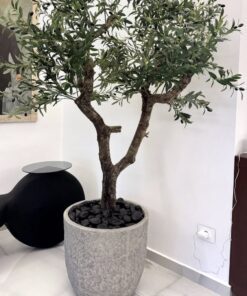
Run a hand along the trunk of a convincing artificial olive tree and the question settles itself before anyone has looked up at the foliage. Bark is not a surface texture. It is a record of decades of growth — splits that opened slowly, hollows where a branch was lost, grain twisting one way and then another. That is the part of a tree the eye has been reading since childhood, and the part that decides whether a piece in your lobby looks like a tree or like a prop.
This is why the trunks in our artificial olive trees are real preserved olive wood rather than moulded imitations — not nostalgia for natural material, but the most reliable way we know to make a tree hold up under close inspection.
People look at foliage from across the room and at the trunk from a metre away
From the doorway, anyone entering reads silhouette and canopy — shape, density, colour. That reading is forgiving, and good foliage handles it easily. But a tree in a restaurant, a hotel lobby or an entrance hall is also something people stand beside, wait next to and photograph. At that range the canopy is above their head and the trunk is directly in front of their eyes, which means the trunk carries the burden of realism exactly where the eye is most critical. Get it wrong and nothing in the canopy compensates.
What “preserved” means in practice
A preserved trunk is real wood treated so it behaves predictably once it leaves the workshop: dried and stabilised so it does not keep moving, cracking or shedding as it settles into an air-conditioned room or a hot terrace.
The word matters, because “real trunk” on its own is not a specification. Untreated wood brought indoors keeps responding to heat and humidity and to the swing between a Lebanese August and a January with the heating on. Preservation is what turns a beautiful piece of olive wood into a component you can build on.
Where moulded trunks give themselves away
Moulded trunks come from a cast, and a cast is a repeated object. That repetition is the tell: the same knot at the same height on two different trees, or a fissure that should run deep into the wood stopping at a shallow, even depth because a mould has to release. Bark reads as evenly rough rather than irregular — dense in one zone, worn smooth in another, split open somewhere else.
Few people articulate any of this. They simply feel something is slightly off — the way a wig can be well made and still register as a wig. Realism is rarely won by one dramatic feature; it is won by the absence of small wrong notes.
The things you cannot design on purpose
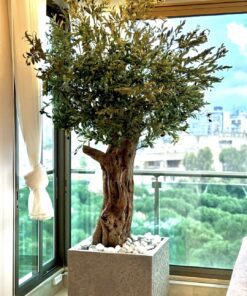
Working from real trunks changes the design process, mostly for the better. A preserved olive trunk arrives with a lean already in it, a base that flares on one side, a fork lower than you would have drawn it. You build the branch structure and canopy around those decisions instead of imposing a plan on them. The result is genuine asymmetry — hard to invent convincingly, because designed irregularity tends to come out rhythmic. It also means every piece is one of one: two trees made in our Jdeideh workshop to the same height will not be twins, which is exactly what you want when they flank an entrance.
Matching character to the space
Because the trunk is selected rather than manufactured to order, part of our job is matching character to setting. A gnarled, heavily hollowed trunk has enormous presence in a double-height space or a rustic restaurant interior. A cleaner, more upright trunk suits a minimal office reception. Both are olive; they say different things.
Durability, indoors and out
A preserved trunk is structural and built to stay that way. Outdoors, the variable that usually matters more is the foliage: sun in Lebanon is relentless, and anti-UV foliage is what keeps an exterior tree from going pale and grey. A real trunk also has real weight and a real centre of gravity, so it has to be anchored into a planter that can hold it against a knock or a gust — which is why we build planters to the tree rather than shopping for one afterwards.
When a fully artificial trunk is the better answer
Honesty is worth more here than a sales line: preserved trunks are not right for everything. Suspended installations, very slim decorative pieces, sculptural forms no real tree ever grew into, and anything with a strict weight limit — a mezzanine, a rooftop with load restrictions — are better served by a trunk we fabricate ourselves. We make both. The deciding factors are weight, geometry and how close people will get to it. For a floor-standing olive, ficus or fruit tree that people pass within arm’s reach every day, the preserved trunk wins almost every time.
Frequently asked questions
Is a preserved trunk still alive?
No. It is real olive wood that has been dried, stabilised and treated. It does not grow, it does not need water, and it does not need light. It is a permanent material, not a plant.
Will it crack or shed bark in my apartment?
That is precisely what the preservation process is for. The wood is stabilised before it is ever built into a tree, so it is not still adjusting to your room’s temperature and humidity the way an untreated piece of wood would be.
Can a preserved trunk go outside?
Yes, and many of ours do — at villa entrances, on terraces and in outdoor restaurant seating. For outdoor placement we specify anti-UV foliage and pay extra attention to weighting and anchoring against wind.
How long does a custom tree take to make?
Around 20 to 25 working days for a custom tree, from approved design to installation. Ready pieces in the showroom can be delivered sooner.
Come and look at one
Realism is hard to judge from photographs, which is rather the point of this article. Our showroom in Jdeideh, facing St. John Greek Orthodox church, has trees you can walk up to and inspect at the distance your guests will. If you have a space in mind, send a photograph of the corner and the ceiling height and we will tell you what works in it. We fabricate everything in-house and deliver and install nationwide.
Message us on WhatsApp or get in touch through our contact page — or browse the full range of custom artificial trees we build.