

Blog
How a Custom Artificial Olive Tree Is Actually Built, Step by Step
Most people meet an artificial olive tree at the end of its story — installed, lit from above, standing in the corner of a lobby as though it had always been there. What nobody sees is the several weeks before that, when the same tree was a bare trunk lying on a workbench in Jdeideh and a stack of foliage crates against the wall.
Because we build every tree ourselves rather than order finished pieces from a catalogue, we can walk you through what happens in between. Here is the sequence, in order.
1. Measuring the space before touching any material
A custom tree starts with three numbers and one photograph. The three numbers are ceiling height, the width the canopy is allowed to occupy, and the size of the spot the base will sit in. The photograph is of the empty corner, taken from where people will normally stand when they look at it.
Those inputs matter more than they sound. A tree that nearly touches the ceiling reads as cramped; the same tree in a double-height stairwell disappears. Canopy width decides whether people walk around the tree or into it. And the viewing angle decides which side gets the denser foliage — a tree seen only from the front need not be finished like a sculpture in the round.
2. Selecting the trunk
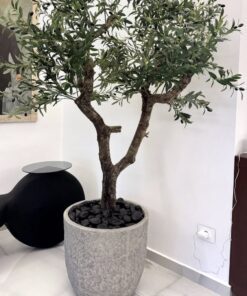
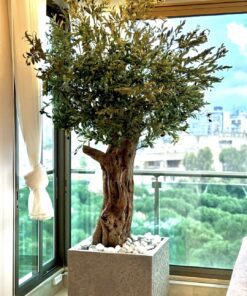
The single thing that separates a convincing olive tree from an obvious one is the trunk. We work with preserved natural trunks — real olive wood, treated so it stays stable indoors and out — rather than moulded plastic imitations.
Nobody can fake the way an old olive trunk twists, splits and hollows. A mould reproduces one such pattern exactly, and that is the giveaway — moulded trunks repeat, and the eye catches repetition long before the brain names it.
Choosing one is a judgement call, not a spec: a lean that suits the position, a base wide enough to sit stable, a branching point that leaves room for the canopy you want.
3. Building the branch structure
Once the trunk is chosen, the branch architecture is built out from it in metal and fixed into the wood. This is the stage that decides the tree’s silhouette, and it is done by eye rather than to a drawing.
Olive canopies are not domes. They are open, slightly asymmetric, with gaps that let light through and a few branches that reach further than the rest. Building a perfectly balanced, evenly spaced crown is the most common way to make an expensive tree look artificial. So branches go on at uneven intervals, at uneven lengths, and the crown is deliberately left a little lopsided.
4. The base, the weighting and the planter
A large tree is top-heavy by definition, and the base is where most problems start. Inside the planter the trunk is anchored and ballasted so the centre of gravity sits low — heavy enough that a shoulder knock, a cleaner’s trolley or a gust across a terrace does not move it.
Planter and tree are sized together. One too small looks precarious even when it is not; one too large swallows the trunk. Outdoors the weighting goes up, because wind loads on a full canopy are considerable.
5. Foliage, branch by branch
Foliage is applied by hand, one cluster at a time — the longest stage of the build.
Density
Too little foliage and you see the structure; too much and the tree turns into a green blob with a trunk under it. Real olive canopies are sparse enough that you can see through them in places, and that see-through quality is what the eye reads as “alive.”
Colour variation
Olive leaves are not one colour. They are grey-green on one face, silver on the other, and older growth sits darker than new. Mixing leaf tones and orientations across the canopy is what stops the tree flattening out under a single light source.
Outdoor foliage
If the tree is going outside — a terrace, an entrance, a poolside — the foliage specified is anti-UV. Standard indoor foliage will hold its colour for years in a lobby and lose it in a Lebanese summer, because the fading is driven by ultraviolet exposure, not by heat or time.
6. Full assembly in the workshop
Before anything leaves, the tree is stood up complete and looked at from a distance. Gaps get filled, over-dense areas thinned, the lean checked against the brief. Then it comes apart again — large trees travel in sections, not whole.
7. Delivery and installation
On site the sections are reassembled, the tree set in position, rotated to its best face, and the canopy opened out by hand — branches compress in transit and need re-spreading. Installation is part of the job, anywhere in Lebanon.
From approved design to installed tree, a custom build typically runs about 20–25 working days.
Why this is worth knowing before you buy
Every stage above is a place where a corner can be cut: a moulded trunk instead of a real one, a symmetrical crown because it is faster, indoor foliage sent outdoors, a light base that saves on shipping. None of that shows in a photograph. All of it shows in the room, within a year.
You can see finished pieces and half-finished ones in the showroom in Jdeideh, facing St. John Greek Orthodox church — the workshop and the showroom are the same address, which is the fastest way to judge whether the work is any good.
Frequently asked questions
Can you build an olive tree to an exact height?
Yes. Trees are made to any size, and height is one of the first things fixed in the brief. If you have a ceiling height and a canopy width, we can build to them.
Is the trunk real wood?
The trunks are preserved natural olive wood. The foliage and branch structure are fabricated; the trunk is the real thing, treated for long-term stability.
Can a custom olive tree go outdoors permanently?
Yes, provided it is specified for outdoors from the start — anti-UV foliage and a heavier, properly anchored base. Retro-fitting an indoor tree for an exposed terrace is not the same thing.
Do you deliver outside Beirut?
We deliver and install nationwide.
Talk to the workshop
If you have a corner in mind, send a photo of it and the ceiling height — that is usually enough for us to tell you what will work and roughly what it involves. Message us on WhatsApp or through the contact page, or come see the olive trees and other custom trees in person in Jdeideh.