

Blog
Leaf by Leaf: How Foliage Density Decides Whether a Tree Looks Convincing
People almost always ask about the trunk first, and almost never about how many leaves are going onto it. It is the wrong way round. A good preserved trunk gets a tree past the first glance; what decides whether it still convinces on the fifth look — from across the room, from underneath, with afternoon sun behind it — is foliage density. Get that wrong and no amount of bark saves the piece.
Density is not the same as “more leaves”
The instinct, when someone wants a full and luxurious tree, is to keep adding foliage until there is no daylight left in the canopy. It is the most common way an artificial tree ends up looking fake. Pack a canopy solid and you get a shape no tree in nature makes: a green mass with a hard outline, closer to a hedge balanced on a stick than to a tree.
Real canopies are uneven by definition. A branch that reached toward light grew long and leafy; one that spent a decade shaded stayed thin. There are holes, places where you can see three branches deep, and places where you cannot see through at all. Density, done properly, means reproducing that variation — not maximising it.
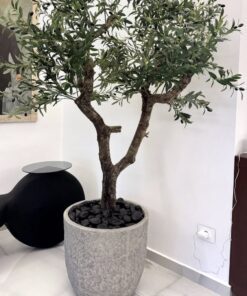
This matters most with the olive. Its foliage is naturally sparse and airy — small narrow leaves, a canopy you can see sky through — so a solidly packed olive reads wrong to a Lebanese eye immediately. Everyone here has stood under a real one.
What the eye is actually checking
The silhouette
Before anyone registers a single leaf, they read the outline of the canopy against the wall behind it. Real outlines are ragged — branch tips poking past the general mass, a lopsided spread, no symmetry. So the edge gets deliberately irregular, with some branches left longer than their neighbours. It feels like a mistake while you are doing it, and it is the difference between a tree and a decoration.
Light through the canopy
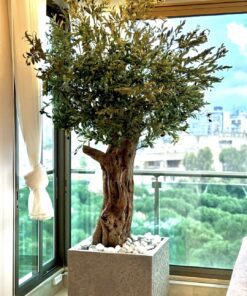
Stand under a real tree and look up: you see a mosaic of bright gaps. Artificial trees are usually judged from below — in a lobby or a stairwell, people walk under them — so the underside needs genuine gaps between leaf clusters rather than a flat green ceiling. Under a skylight or a tall window, this is what gives a poor canopy away first.
Leaf scale from trunk to tip
On a real branch, leaves are not one size. Older growth near the trunk carries larger, darker leaves; new growth at the tips is smaller and lighter. Building that gradient in — larger foliage inboard, finer sprays at the ends — is slow work, and it is most of what separates a handmade tree from an assembled one.
Density is decided for the room, not in the abstract
There is no correct density in general, only the right density for a specific space. Three things set it.
Viewing distance. A tree in a villa entrance that people pass within arm’s reach is judged on leaf detail. A tree filling a double-height atrium is judged almost entirely on silhouette and mass, because nobody will be close enough to examine a leaf. The tall piece needs a stronger, simpler canopy shape; the close one needs restraint and fine work at the tips.
Light. A dim corner swallows foliage. A moderately dense canopy in a badly lit corner of a restaurant flattens into a dark blob with no depth, while the same canopy under a skylight looks twice as full, because every gap is edged with light. Dark rooms generally want more open foliage and lighter leaf tones so the structure survives.
Ceiling height and canopy width. Density and proportion are one decision, not two. A tree scaled to a 3-metre ceiling and one scaled to a 7-metre stairwell need different foliage weight, or the tall one looks starved and the short one top-heavy. This is the practical reason to build to measure: you cannot resize a finished canopy afterwards without it showing. Our custom artificial trees are specified around the real dimensions of the space, and the foliage plan follows from that.
How the canopy is set in the workshop
In our Jdeideh workshop, foliage goes on after the branch structure is built and balanced, and it goes on from the inside out: inner branches, then mid-canopy, then the outer sprays that form the silhouette. The tree is turned repeatedly and checked from a distance, because density that looks right at 30 centimetres often looks clumpy at five metres.
Outdoors — villa entrances, terraces, poolside — foliage narrows to anti-UV grades, and density takes on a second job: wind. A canopy built too solid behaves like a sail and loads the base. Open, layered foliage lets air through and keeps the piece stable.
Green walls are the same problem in two dimensions. A panel packed with one uniform foliage reads as a product; depth comes from mixing leaf sizes and tones and varying density across the surface, which is how our artificial green walls are finished.
Three tests before you buy
- Step back five metres. Is the outline ragged and plant-like, or a tidy oval?
- Look up from underneath. Can you see gaps and branch structure, or a flat green mat?
- Compare tip to trunk. Are the leaves at the ends finer and lighter than those nearer the middle?
FAQ
Will a denser artificial tree last longer?
No. Density affects how convincing a tree looks, not how long it lasts. Longevity comes from the foliage grade — anti-UV outdoors — the branch structure and the weighting of the base. A very dense outdoor canopy can even shorten a piece’s life by catching wind.
Can foliage density be changed after installation?
It can be adjusted a little, and canopies can be refreshed years later. Large changes mean rebuilding the canopy, because branch spacing is planned around foliage weight from the start. Far better to settle density before fabrication.
Do you build to a specific size?
Yes — trees are made to any size, with canopy width, height and foliage weight set from the room’s measurements. Custom trees run around 20–25 working days, with delivery and installation anywhere in Lebanon.
Come and look at a canopy in person
Density is hard to judge in a photograph and easy to judge in a room. Our showroom is in Jdeideh, Metn, facing St. John Greek Orthodox church — walk around the trees and look up into the canopies.
If you have a space in mind, send a photo and a rough ceiling height on WhatsApp and we will tell you what canopy size and foliage weight that room needs — or reach us through the contact page.